


Ultimate Guide to the SPLK-3003 - Latest Oct 30, 2024 Edition Available Now
2024 Updated Verified Pass SPLK-3003 Exam - Real Questions and Answers
Splunk SPLK-3003 certification exam is designed for individuals who possess advanced-level knowledge and skills in administering, deploying, and troubleshooting Splunk Enterprise. SPLK-3003 exam tests the candidate's ability to configure and manage Splunk deployments, create and maintain advanced dashboards and alerts, analyze complex data sets, and design and implement Splunk apps. Splunk Core Certified Consultant certification is ideal for individuals who are seeking to demonstrate their expertise in Splunk and enhance their career prospects in the field of data analytics.
NEW QUESTION # 45
Which configuration item should be set to false to significantly improve data ingestion performance?
- A. AUTO_KV_JSON
- B. BREAK_ONLY_BEFORE_DATE
- C. ANNOTATE_PUNCT
- D. SHOULD_LINEMERGE
Answer: D
Explanation:
https://docs.splunk.com/Documentation/Splunk/8.0.6/Data/Configureeventlinebreaking
NEW QUESTION # 46
A customer has asked for a five-node search head cluster (SHC), but does not have the storage budget to use a replication factor greater than 2. They would like to understand what might happen in terms of the users' ability to view historic scheduled search results if they log onto a search head which doesn't contain one of the 2 copies of a given search artifact.
Which of the following statements best describes what would happen in this scenario?
- A. Because the dispatch folder containing the search results is not present on the search head, the user will not be able to view the search results.
- B. The search head that the user has logged onto will proxy the required artifact over to itself from a search head that currently holds a copy. A copy will also be replicated from that search head permanently, so it is available for future use.
- C. The user will not be able to see the results of the search until one of the search heads is restarted, forcing synchronization of all dispatched artifacts across all search heads.
- D. The user will not be able to see the results of the search until the Splunk administrator issues the apply shcluster-bundle command on the search head deployer, forcing synchronization of all dispatched artifacts across all search heads.
Answer: B
NEW QUESTION # 47
Which statement is true about subsearches?
- A. Subsearches work best for joining two large result sets.
- B. Subsearches work best for small result sets.
- C. Subsearches are faster than other types of searches.
- D. Subsearches run at the same time as their outer search.
Answer: C
NEW QUESTION # 48
The customer wants to migrate their current Splunk Index cluster to new hardware to improve indexing and search performance. What is the correct process and procedure for this task?
- A. 1. Install new indexers.
2.Configure indexers into the cluster as peers; ensure they receive the same configuration via the deployment server.
3.Update forwarders to forward to the new peers.
4.Decommission old peers on at a time.
5.Restart the cluster master (CM). - B. 1. Install new indexers.
2.Configure indexers into the cluster as peers; ensure they receive the cluster bundle and the same configuration as original peers.
3.Decommission old peers one at a time.
4.Remove old peers from the CM's list.
5.Update forwarders to forward to the new peers. - C. 1. Install new indexers.
2.Configure indexers into the cluster as peers; ensure they receive the same configuration via the deployment server.
3.Decommission old peers one at a time.
4.Remove old peers from the CM's list.
5.Update forwarders to forward to the new peers. - D. 1. Install new indexers.
2.Configure indexers into the cluster as peers; ensure they receive the cluster bundle and the same configuration as original peers.
3.Update forwarders to forward to the new peers.
4.Decommission old peers one at a time.
5.Remove old peers from the CM's list.
Answer: A
NEW QUESTION # 49
Which of the following processor occur in the indexing pipeline?
- A. UTF-8, linebreaker, header
- B. tcp out, syslog out
- C. Aggregator
- D. Regex replacement, annotator
Answer: B
Explanation:
IndexPipe: Tcpout to another Splunk, syslog output, and indexing are done here.
In addition, this pipeline is responsible for bytequota, block signing, and indexing metrics such as thruput etc.
https://wiki.splunk.com/Community:HowIndexingWorks
NEW QUESTION # 50
A customer has implemented their own Role Based Access Control (RBAC) model to attempt to give the Security team different data access than the Operations team by creating two new Splunk roles - security and operations. In the srchIndexesAllowed setting of authorize.conf, they specified the network index under the security role and the operations index under the operations role. The new roles are set up to inherit the default user role.
If a new user is created and assigned to the operations role only, which indexes will the user have access to search?
- A. No Indexes
- B. operations
- C. operations, network
- D. operations, network, _internal, _audit
Answer: D
NEW QUESTION # 51
In the diagrammed environment shown below, the customer would like the data read by the universal forwarders to set an indexed field containing the UF's host name. Where would the parsing configurations need to be installed for this to work?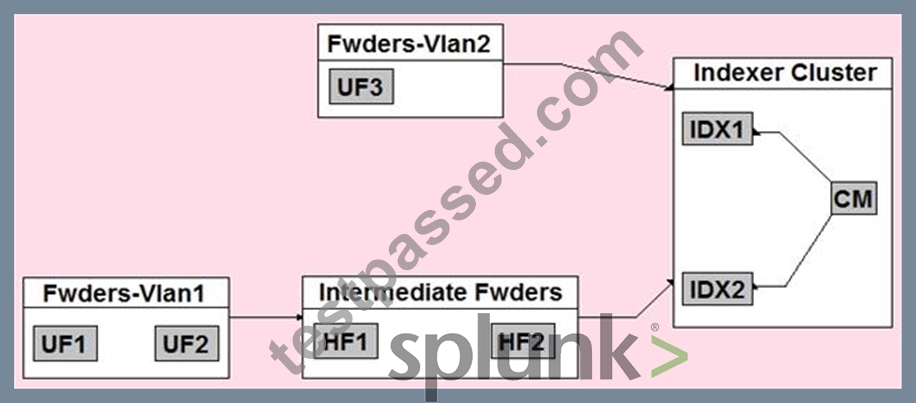
- A. On all parsing Splunk instances.
- B. All universal forwarders.
- C. Only the indexers.
- D. All heavy forwarders.
Answer: A
NEW QUESTION # 52
When using SAML, where does user authentication occur?
- A. Splunk generates a SAML assertion that authenticates the user.
- B. The Identity Provider (IDP) decodes the SAML request and authenticates the user.
- C. The Service Provider (SP) decodes the SAML request and authenticates the user.
- D. The Service Provider (SP) generates a SAML assertion that authenticates the user.
Answer: A
NEW QUESTION # 53
When a bucket rolls from cold to frozen on a clustered indexer, which of the following scenarios occurs?
- A. All replicated copies will be rolled to frozen; original copies will remain.
- B. Nothing. Replicated copies of the bucket will remain on all other indexers until a local retention rule causes it to roll.3
- C. Replicated copies of the bucket will remain on all other indexers and the Cluster Master (CM) assigns a new primary bucket.
- D. The bucket rolls to frozen on all clustered indexers simultaneously.
Answer: C
Explanation:
https://docs.splunk.com/Documentation/Splunk/8.1.0/Indexer/Bucketsandclusters
NEW QUESTION # 54
In an environment that has Indexer Clustering, the Monitoring Console (MC) provides dashboards to monitor environment health. As the environment grows over time and new indexers are added, which steps would ensure the MC is aware of the additional indexers?
- A. Using the MC setup UI, review and apply the changes.
- B. No changes are necessary, the Monitoring Console has self-configuration capabilities.
- C. Remove and re-add the cluster master from the indexer clustering UI page to add new peers, then apply the changes under the MC setup UI.
- D. Each new indexer needs to be added using the distributed search UI, then settings must be saved under the MC setup UI.
Answer: A
Explanation:
https://community.splunk.com/t5/Monitoring-Splunk/new-indexer-not-showing-in-Monitoring- console/m-p/318832
NEW QUESTION # 55
Monitoring Console (MC) health check configuration items are stored in which configuration file?
- A. distsearch.conf
- B. alert_actions.conf
- C. checklist.conf
- D. healthcheck.conf
Answer: C
Explanation:
https://docs.splunk.com/Documentation/Splunk/8.1.0/DMC/Customizehealthcheck
NEW QUESTION # 56
A customer would like to remove the output_file capability from users with the default user role to stop them from filling up the disk on the search head with lookup files. What is the best way to remove this capability from users?
- A. Clone the default user role, remove the output_file capability, and assign it to the users.
- B. Create a new role without the output_file capability that inherits the default user role and assign it to the users.
- C. Create a new role with the output_file capability that inherits the default user role and assign it to the users.
- D. Edit the default user role and remove the output_file capability.
Answer: D
NEW QUESTION # 57
Which of the following is the most efficient search?
- A. index=www status=200 uri=/cart/checkout | append [search index = sales] | stats count, sum(revenue) as total_revenue by session_id | table total_revenue session_id
- B. (index=www) OR (index=sales) | search (index=www status=200 uri=/cart/checkout) OR (index=sales) | stats count, sum(revenue) as total_revenue by session_id | table total_revenue session_id
- C. (index=www status=200 uri=/cart/checkout) OR (index=sales) | stats count, sum (revenue) as total_revenue by session_id | table total_revenue session_id
- D. index=www | append [search index = sales] | stats count, sum(revenue) as total_revenue by session_id | table total_revenue session_id
Answer: C
NEW QUESTION # 58
A customer has a search cluster (SHC) of six members split evenly between two data centers (DC). The customer is concerned with network connectivity between the two DCs due to frequent outages. Which of the following is true as it relates to SHC resiliency when a network outage occurs between the two DCs?
- A. The SHC will function as expected as the SHC captain will fall back to previous active captain in the remaining site.
- B. The SHC will stop all scheduled search activity within the SHC.
- C. The SHC will function as expected as the SHC deployer will become the new captain until the network communication is restored.
- D. The SHC will function as expected as the minimum required number of nodes for a SHC is 3.
Answer: A
NEW QUESTION # 59
How could a role in which all users must specify an index=clause in all searches be configured?
- A. Set the authorize.conf setting: srchJobsQuota to no value.
- B. Set the authorize.conf setting: srchIndexesAllowed to no value.
- C. Set the authorize.conf setting: srchFilter to no value.
- D. Set the authorize.conf setting: srchIndexesDefault to no value.
Answer: D
Explanation:
https://community.splunk.com/t5/Archive/srchIndexesDefault-parameter-is-not-respected-when- srchFilter-is/m-p/495869
NEW QUESTION # 60
What is the primary driver behind implementing indexer clustering in a customer's environment?
- A. To reduce indexing latency.
- B. To provide higher availability for buckets of data.
- C. To improve resiliency as the search load increases.
- D. To scale out a Splunk environment to offer higher performance capability.
Answer: B
Explanation:
https://docs.splunk.com/Documentation/Splunk/8.1.0/Indexer/Howclusteredsearchworks
NEW QUESTION # 61
Which of the following server roles should be configured for a host which indexes its internal logs locally?
- A. Indexer
- B. Cluster master
- C. Monitoring Console (MC)
- D. Search head
Answer: A
NEW QUESTION # 62
The customer has an indexer cluster supporting a wide variety of search needs, including scheduled search, data model acceleration, and summary indexing. Here is an excerpt from the cluster mater's server.conf:
Which strategy represents the minimum and least disruptive change necessary to protect the searchability of the indexer cluster in case of indexer failure?
- A. Convert the cluster to multi-site and modify the server.conf to be site_replication_factor=2, site_search_factor=2.
- B. Enable maintenance mode on the CM to prevent excessive fix-up and bring the failed indexer back online.
- C. Leave replication_factor=2, increase search_factor=2 and enable summary_replication.
- D. Increase replication_factor=3, search_factor=2 to protect the data, and allow there to always be a searchable copy.
Answer: D
NEW QUESTION # 63
......
Dumps Moneyack Guarantee - SPLK-3003 Dumps Approved Dumps: https://testking.testpassed.com/SPLK-3003-pass-rate.html