


Share Latest Oct-2025 FAR DUMP with 165 Questions and Answers
PDF Dumps 2025 Exam Questions with Practice Test
Topics of Financial Accounting and Reporting (FAR) Exam
The syllabus for the Financial Accounting and Reporting (FAR) part of the Certified Public Accountant (CPA) Exam can be found in the FAR exam dumps and is also listed below with detail of each area of concern and their topics:
Area 1 - Conceptual Framework, Standard-Setting and Financial Reporting (25-35%)
Objectives covered by this section:
- General-purpose financial statements: for-profit business entities
- General-purpose financial statements: nongovernmental, not-for-profit entities
- Conceptual framework and standard-setting for business and non-business entities
- Statement of comprehensive income
- Discontinued operations
- Balance sheet/ statement of financial position
- Income statement/ statement of profit or loss
- Financial statements of employee benefit plans
- Statement of financial position
- Public company reporting topics (U.S. SEC reporting requirements, earnings per share, and segment reporting)
- Special purpose frameworks
- Statement of changes in equity
- Notes to financial statements
Area 2 - Select Financial Statement Accounts (30-40%)
Objectives covered by this section:
- Income taxes
- Trade receivables
- Equity
- Retirement benefits
- Investments
- Cash and cash equivalents
- Stock compensation (share-based payments)
- Property, plant, and equipment
- Financial assets at fair value
- Inventory
- Long-term debt (financial liabilities)
- Equity method investments
- Intangible assets - goodwill and other
Area 3 - Select Transactions (20-30%)
Objectives covered by this section:
- Nonreciprocal transfers
- Foreign currency transactions and translation
- Software costs
- Business combinations
- Contingencies and commitments
- Subsequent events
Area IV - State and Local Governments (5-15%)
Objectives covered by this section:
- Budgetary comparison reporting
- Nonexchange revenue transactions
- Government-wide financial statements
- Net position and components thereof
- Management's discussion and analysis
- Other financing sources and uses
- Expenditures and expenses
- Fiduciary funds financial statements
- Deriving government-wide financial statements and reconciliation requirements
- Budgetary accounting and encumbrances
- Financial reporting entity, including blended and discrete component units
- Proprietary funds financial statement
- Special items
- State and local government concepts
- Capital assets and infrastructure assets
- Governmental funds financial statements
- Interfund activity, including transfers
Financial Accounting and Reporting (FAR) Exam Certification Path
Generally, the more familiar you are with the FAR content, the less time you need to study, and the faster you can pass. So, how long will you need to study for FAR? Well, the best you can get is the FAR exam dumps that help you figure out what side of the study time spectrum you're probably on via a deeper investigation into FAR's content. You'll find the content areas, groups, and topics of FAR in the FAR CPA Exam blueprints.
Want to pass FAR fast? Then you'll need to study for 20 hours a week so you can finish your review in 6-8 weeks.
Can't fit that much study time into your routine? Then try studying for 15 hours a week. Doing so will prepare you in 8-11 weeks.
finally, if you can only study for 10 hours a week, you'll be ready for FAR in 12-16 weeks.
So, you can use any one of these study schedules or do anything in between. That's because of how fast you finish your FAR review depends on how much time you have to study in a week. But what's important is that you study consistently so you can stay in study mode and stick to your exam schedule.
NEW QUESTION # 15
For interim financial reporting, the computation of a company's second quarter provision for income taxes
uses an effective tax rate expected to be applicable for the full fiscal year. The effective tax rate should
reflect anticipated: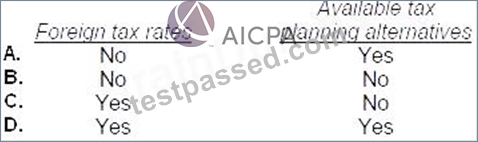
- A. Option D
- B. Option B
- C. Option A
- D. Option C
Answer: A
Explanation:
Choice "d" is correct. Yes - Yes.
The effective income tax rates for operations for the full year should reflect anticipated foreign tax rates
and available tax planning alternatives. In addition, the effect of other anticipated tax credits, capital gains
rates, and foreign tax credits should be included.
NEW QUESTION # 16
Which of the following is true regarding the presentation of "comprehensive income."
- A. Option C
- B. Option D
- C. Option B
- D. Option A
Answer: A
Explanation:
Choice "c" is correct. No - Yes.
Comprehensive income may be shown on the face of a combined "statement of income and
comprehensive income" a separate section below net income, or in:
1 . Separate "statement of comprehensive income," or as a
2 . Component of the "statement of changes of owners' equity."
The income tax expense or benefit allocated to components must be disclosed, either on the face of the
statement or in notes to the statement.
Choices "a", "b", and "d" are incorrect, per the above rules.
NEW QUESTION # 17
Arpco, Inc., a for-profit provider of healthcare services, recently purchased two smaller companies and is
researching accounting issues arising from the two business combinations. Which of the following
accounting pronouncements are the most authoritative?
- A. AICA Statements of Position.
- B. FASB Statements of Financial Accounting Standards.
- C. FASB Statements of Financial Accounting Concepts.
- D. AICPA Industry and Audit Guides.
Answer: B
Explanation:
Choice "d" is correct. Since Arpco is a for-profit provider of healthcare services, it is covered under normal
GAAP. Thus, the most authoritative pronouncements are the FASB Statements of Financial Accounting
Standards (SFAS). Choice "a" is incorrect. AICPA Statements of Position are not the most authoritative
pronouncement for almost anything (other than for some issues that only they cover). They are normally
"merely" the opinion of the AICPA.
Choice "b" is incorrect. AICPA Industry and Audit Guides are not the most authoritative pronouncement
for almost anything (other than for some issues that only they cover). Choice "c" is incorrect. FASB
Statements of Financial Accounting Concepts are not authoritative pronouncements except where they
have been incorporated by reference into an SFAS. They are the basis on which SFAS can be
constructed.
NEW QUESTION # 18
In 1992, hail damaged several of Toncan Co.'s vans. Hailstorms had frequently inflicted similar damage to
Toncan's vans. Over the years, Toncan had saved money by not buying hail insurance and either paying
for repairs, or selling damaged vans and then replacing them. In 1992, the damaged vans were sold for
less than their carrying amount. How should the hail damage cost be reported in Toncan's 1992 financial
statements?
- A. The actual 1992 hail damage loss as an extraordinary loss, net of income taxes.
- B. The actual 1992 hail damage loss in continuing operations, with no separate disclosure.
- C. The expected average hail damage loss in continuing operations, with separate disclosure.
- D. The expected average hail damage loss in continuing operations, with no separate disclosure.
Answer: B
Explanation:
Choice "b" is correct. Actual hail damage must be reported. Since the hailstorms are frequent, the
damage is not considered an extraordinary gain/loss. Thus, the damages would be shown in continuing
operations. No separate disclosure is necessary since hail damage is a common occurrence. Choice "a"
is incorrect. Hailstorms are not unusual and infrequent so the loss could not be classified as extraordinary.
APB 30 para. 20 Choice "c" is incorrect. Actual hail damage must be reported. Estimated hail damage
may be probable but is not estimable; so it should not be included in income calculations. Choice "d" is
incorrect. Estimated hail damage may be probable but is not estimable; so it should not be included in
income calculations.
NEW QUESTION # 19
A change from the cost approach to the market approach of measuring fair value is considered to be what
type of accounting change?
- A. Change in accounting estimate.
- B. Change in valuation technique.
- C. Change in accounting principle.
- D. Error correction.
Answer: A
Explanation:
Choice "a" is correct. A change in the valuation technique used to measure fair value is a change in
accounting estimate. Choice "b" is incorrect. Per SFAS No. 157, a change in valuation technique is a
change in accounting estimate, not a change in accounting principal. Choice "c" is incorrect. Although a
change from the cost approach to the market approach is a change in valuation technique, a change in
valuation technique is not defined as a type of accounting change, but instead falls into the category of
changes in accounting estimate. Choice "d" is incorrect. Both the market approach and the cost approach
are acceptable methods of measuring fair value per SFAS No. 157; therefore, switching between these
methods is not the correction of an error. Additionally, an error correction is not a type of accounting
change.
NEW QUESTION # 20
On January 2, 20X5, to better reflect the variable use of its only machine, Holly, Inc. elected to change its
method of depreciation from the straight-line method to the units of production method. The original cost
of the machine on January 2, 20X3, was $50,000, and its estimated life was 10 years. Holly estimates that
the machine's total life is 50,000 machine hours. Machine hours usage was 8,500 during 20X4 and 3,500
during 20X3.
Holly's income tax rate is 30%. Holly should report the accounting change in its 20X5 financial statements
as a(n):
- A. Cumulative effect of a change in accounting principle of $2,000 in its income statement.
- B. Cumulative effect of a change in accounting principle of $1,400 in its income statement.
- C. Adjustment to beginning retained earnings of $2,000.
- D. None of the above.
Answer: D
Explanation:
Choice "d" is correct. A change in the method of depreciation is now considered to be both a change in
method and a change in estimate. These changes should be accounted for as changes in estimate and
handled prospectively. The new depreciation method should be used as of the beginning of the year of
change and should start with the current book value of the underlying asset. No retroactive or
retrospective calculations should be made, and no adjustment should be made to retained earnings. The
cumulative effect treatment on the income statement was the treatment of most changes in accounting
principle prior to SFAS No. 154. The adjustment to beginning retained earnings is the treatment now
given to changes in accounting principle by SFAS No. 154. However a change in depreciation method is
no longer accounted for as a change in accounting principle. Choices "a", "b", and "c" are incorrect, per
the above Explanation: .
NEW QUESTION # 21
In financial reporting of segment data, which of the following must be considered in determining if an
industry segment is a reportable segment?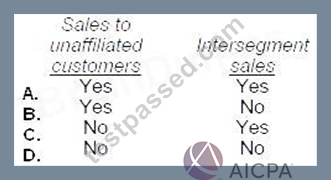
- A. Option D
- B. Option A
- C. Option B
- D. Option C
Answer: B
Explanation:
Choice "a" is correct. A segment is considered reportable if its reported revenue, including sales to
unaffiliated customers and intersegment sales, is 10% or more of the combined revenue (unaffiliated and
intersegment) of all operating segments.
Choices "b", "c", and "d" are incorrect, per the above Explanation: .
NEW QUESTION # 22
What information should a public company present about revenues from its reporting segments?
- A. Disclose as a combined amount sales to unaffiliated customers and intracompany sales between
geographic areas. - B. No disclosure of revenues from foreign operations need be reported.
- C. Disclose separately the amount of sales to unaffiliated customers and the amount of intracompany
sales. - D. Disclose separately the amount of sales to unaffiliated customers but not the amount of intracompany
sales between geographic areas.
Answer: C
Explanation:
Choice "a" is correct. Unaffiliated customers sales and intracompany sales must be disclosed separately.
NEW QUESTION # 23
Which of the following should be reported as a prior period adjustment?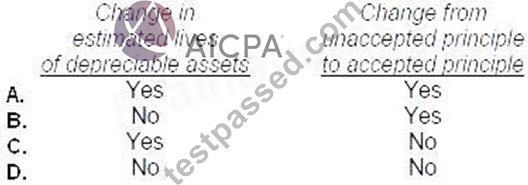
- A. Option D
- B. Option B
- C. Option A
- D. Option C
Answer: B
Explanation:
Choice "b" is correct. No - Yes Change in estimated lives of depreciable assets is a "change in estimate."
They affect only current and future periods (not "prior periods," not retained earnings). Change from
unaccepted principle to accepted principle is an example of an error of a prior period that should be
reported as a "prior period adjustment."
NEW QUESTION # 24
During a period when an enterprise is under the direction of a particular management, its financial
statements will directly provide information about:
- A. Enterprise performance but not directly provide information about management performance.
- B. Neither enterprise performance nor management performance.
- C. Both enterprise performance and management performance.
- D. Management performance but not directly provide information about enterprise performance.
Answer: A
Explanation:
Choice "c" is correct. Financial reporting, and especially financial statements, usually cannot and do not
separate management performance from enterprise performance. Financial reporting provides
information about an enterprise during a period when it was under the direction of a particular
management but does not directly provide information about that management's performance. SFAC 1
para. 53
NEW QUESTION # 25
FASB's conceptual framework explains both financial and physical capital maintenance concepts. Which
capital maintenance concept is applied to currently reported net income, and which is applied to
comprehensive income?
- A. Option C
- B. Option D
- C. Option B
- D. Option A
Answer: A
Explanation:
Choice "c" is correct. Financial capital - Financial capital.
Financial capital maintenance is considered to be an element of both "currently reported net income" and
"comprehensive income." This was a rare instance in which this type of information was asked on the
exam.
NEW QUESTION # 26
Thorpe Co.'s income statement for the year ended December 31, 1990, reported net income of $74,100.
The auditor raised questions about the following amounts that had been included in net income:
The loss from the fire was an infrequent but not unusual occurrence in Thorpe's line of business.
Thorpe's December 31, 1990, income statement should report net income of:
- A. $81,600
- B. $66,100
- C. $65,000
- D. $87,000
Answer: D
Explanation:
Net income before adjustments
Rule: Unrealized losses (or gains) resulting from changes in market value of available-for-sale
investments should be reported as a component of other comprehensive income in shareholders' equity.
Unrealized gains and losses on investments held for trading would be included in net income.
Correction of errors of prior periods should be reported as an adjustment to beginning retained earnings,
not as an item of net income.
Choice "d" is correct. $87,000.
NEW QUESTION # 27
In the hierarchy of generally accepted accounting principles, APB Opinions have the same authority as
AICPA:
- A. Statements of Position.
- B. Accounting Research Bulletins.
- C. Industry Audit and Accounting Guides.
- D. Issues Papers.
Answer: B
Explanation:
Choice "d" is correct. AICPA Accounting Research Bulletins, FASB Standards, FASB Interpretations,
FASB Staff Positions, FASB Statement 133 Implementation Issues, and APB Opinions and
Interpretations are the most authoritative sources of generally accepted accounting principles. Choice "a"
is incorrect. AICPA Statements of Position, AICPA Accounting and Auditing Guides, and FASB Technical
Bulletins are secondary sources of generally accepted accounting principles. Choice "b" is incorrect.
AICPA Statements of Position, AICPA Accounting and Auditing Guides, and FASB Technical Bulletins
are secondary sources of generally accepted accounting principles. Choice "c" is incorrect. AICPA Issues
Papers and Practice Bulletins, FASB Concepts Statements, and other authoritative pronouncements are
tertiary sources for generally accepted accounting principles.
NEW QUESTION # 28
On January 2, 1989, Union Co. purchased a machine for $264,000 and depreciated it by the straight-line
method using an estimated useful life of eight years with no salvage value. On January 2, 1992, Union
determined that the machine had a useful life of six years from the date of acquisition and will have a
salvage value of $24,000. An accounting change was made in 1992 to reflect the additional data. The
accumulated depreciation for this machine should have a balance at December 31, 1992, of:
- A. $160,000
- B. $154,000
- C. $176,000
- D. $146,000
Answer: D
Explanation:
Choice "d" is correct, $146,000 accumulated depreciation balance at DeC. 31, 1992.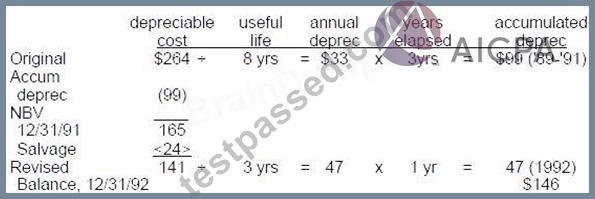
NEW QUESTION # 29
What is the purpose of information presented in notes to the financial statements?
- A. To provide recognition of amounts not included in the totals of the financial statements.
- B. To present management's responses to auditor comments.
- C. To provide disclosures required by generally accepted accounting principles.
- D. To correct improper presentation in the financial statements.
Answer: C
NEW QUESTION # 30
Which of the following should be disclosed in a summary of significant accounting policies?
I. Management's intention to maintain or vary the dividend payout ratio.
II. Criteria for determining which investments are treated as cash equivalents.
III. Composition of the sales order backlog by segment.
- A. II only.
- B. I and III.
- C. I only.
- D. II and III.
Answer: A
Explanation:
Choice "c" is correct. Il only.
The criteria for determining which investments are treated as "cash equivalents" is a method of
accounting policies that needs to be disclosed in the summary of significant accounting policies.
Choice "a" is incorrect. Management's intention to maintain or vary the "dividend payout ratio" is not an
"accounting policy."
Choices "b" and "d" are incorrect. Composition of the sales order backlog by segment is not an
"accounting policy."
NEW QUESTION # 31
During 1990, Fuqua Steel Co. had the following unusual financial events occur:
. Bonds payable were retired five years before their scheduled maturity, resulting in a $260,000 gain.
Fuqua has frequently retired bonds early when interest rates declined significantly.
. A steel forming segment suffered $255,000 in losses due to hurricane damage. This was the fourth
similar loss sustained in a 5-year period at that location.
. A component of Fuqua's operations, steel transportation, was sold at a net loss of $350,000.
This was Fuqua's first divestiture of one of its operating segments.
Before income taxes, what amount of gain (loss) should be reported separately as a component of
income from continuing operations in 1990?
- A. $(350,000)
- B. $260,000
- C. $5,000
- D. $(255,000)
Answer: C
Explanation:
Choice "b" is correct. $5,000.
The steel forming segment's hurricane damage (4th in 5 years) of $255,000 is only "unusual in nature"
and does not occur infrequently, therefore, it is not an "extraordinary item," and should be reported
separately as a component of "income from continuing operations."
The retirement of debt, although unusual, is not infrequent for the company; therefore, the gain does not
qualify for classification as an extraordinary item per APBO No. 30 (and SFAS No. 145).
NEW QUESTION # 32
Hyde Corp. has three manufacturing divisions, each of which has been determined to be a reportable
segment. In 1989, Clay division had sales of $3,000,000, which was 25% of Hyde's total sales, and had
operating costs of $1,900,000, as reported to the CFO. In 1989, Hyde incurred operating costs of
$ 500,000 that were not directly traceable to any of the divisions. In addition, Hyde incurred corporate
interest expense of $300,000 in 1989. In reporting segment information, what amount should be shown as
Clay's operating profit for 1989?
- A. $975,000
- B. $875,000
- C. $900,000
- D. $1,100,000
Answer: D
Explanation:
Choice "d" is correct. $1,100,000 operating profit for clay.
Rule: Operating profit by segments is based on the measure of profit reported to the "chief operating
decision maker."
Allocations for general operating costs and interest, etc., should not be made solely for purposes of
segment disclosures.
NEW QUESTION # 33
On March 15, 1992, Krol Co. paid property taxes of $90,000 on its office building for the calendar year
1 992. On April 1, 1992, Krol paid $150,000 for unanticipated repairs to its office equipment. The repairs
will benefit operations for the remainder of 1992. What is the total amount of these expenses that Krol
should include in its quarterly income statement for the three months ended June 30, 1992?
- A. $97,500
- B. $37,500
- C. $72,500
- D. $172,500
Answer: C
Explanation:
Rule: Actual and estimated expenditures benefiting all interim periods equally should be expensed ratably
throughout the year.
Choice "c" is correct. $72,500 total expense for the three months ended June 30, 1992.
NEW QUESTION # 34
How should the effect of a change in accounting principle that is inseparable from the effect of a change in
accounting estimate be reported?
- A. By footnote disclosure only.
- B. By restating the financial statements of all prior periods presented.
- C. As a correction of an error.
- D. As a component of income from continuing operations.
Answer: D
Explanation:
Choice "a" is correct. When the effect of a change in accounting principle is inseparable from the effect of
a change in accounting estimate, the reporting treatment for the overall effect is as a change in estimate.
Thus, the effect is reported prospectively as a component of income from continuing operations. Under
SFAS No. 154, this type of change is now called a change in accounting estimate affected by a change in
accounting principle. Choice "b" is incorrect. Restatement of all prior periods is the retroactive accounting
treatment that is applied to the correction of an error and the retrospective accounting treatment given to
changes in accounting principle. However, a change in accounting principle that is inseparable from the
effect of a change in accounting estimate is now treated as a change in accounting estimate. Choice "c" is
incorrect. Correction of an error is given retroactive treatment as a prior period adjustment to retained
earnings with restatement of prior periods. This is not the treatment appropriate for the effect of a change
in accounting principle that is inseparable from the effect of a change in accounting estimate. Choice "d"
is incorrect. While footnote disclosure is always appropriate for an accounting change, such disclosure
alone is never the appropriate accounting treatment.
NEW QUESTION # 35
Chester Corp. was a development stage enterprise from its inception on September 1, 1987 to December
3 1, 1988. The following information was taken from Chester's accounting records for the above period:
For the period September 1, 1987 to December 31, 1988, what amount should Chester report as net
loss?
- A. $450,000
- B. $150,000
- C. $350,000
- D. $ 50,000
Answer: A
Explanation:
Choice "d" is correct. $450,000 net loss for the period Sept. 1, 1987 to DeC. 31, 1988.
Rule: "Development stage enterprises" present their FS in accordance with GAAP and make additional
disclosures such as: cumulative net losses, cumulative deficit, cumulative sales and expenses.
NEW QUESTION # 36
The following information pertains to Aria Corp. and its divisions for the year ended December 31, 1988:
Aria and all of its divisions are engaged solely in manufacturing operations. Aria has a reportable segment
if that segment's revenue exceeds:
- A. $260,000
- B. $264,000
- C. $200,000
- D. $204,000
Answer: A
Explanation:
Choice "b" is correct. $260,000 represents a reportable segment (10% of total sales):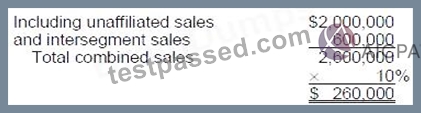
Rule: To be significant enough to report on, a segment must be at least 10% of:
1 . Combined revenues (whether intersegment or unaffiliated customers), or
2 . Operating income, or
3 . Identifiable assets.
NEW QUESTION # 37
What is the purpose of information presented in notes to the financial statements?
- A. To provide recognition of amounts not included in the totals of the financial statements.
- B. To present management's responses to auditor comments.
- C. To provide disclosures required by generally accepted accounting principles.
- D. To correct improper presentation in the financial statements.
Answer: C
Explanation:
Choice "a" is correct. Information presented in notes to the financial statements have the purpose of
providing disclosures required by generally accepted accounting principles. SFAC 5 para. 7
NEW QUESTION # 38
In financial reporting of segment data, which of the following items is always used in determining a
segment's operating income?
- A. Gain or loss on discontinued operations.
- B. Income tax expense.
- C. Sales to other segments.
- D. General corporate expense.
Answer: C
Explanation:
Choice "b" is correct. Sales to other segments would be used in determining a segment's operating
income. Rule: Equity in net income of another company, general corporate expenses, interest, income tax
expense, and gains or losses on discontinued operations are all not included in segment profit unless they
are included in the determination of segment profit reported to the "Chief Operating Decision Maker."
NEW QUESTION # 39
......
Dumps for Free FAR Practice Exam Questions: https://testking.testpassed.com/FAR-pass-rate.html