


Best Quality Guidewire InsuranceSuite-Developer Exam Questions TestPassed Realistic Practice Exams [2026]
Critical Information To Associate Certification - InsuranceSuite Developer - Mammoth Proctored Exam Pass the First Time
NEW QUESTION # 38
Which logging statement follows best practice?
- A. logger.info(logPrefix + " [Address#AddressLine1 = " + address.AddressLine1 + " ] [Address#City " + address.City + " ] [Address#State " + address.State + " ] " )
- B. if(logger.DebugEnabled) { logger.debug(logPrefix + someReallyExpensiveOperation()) }
- C. if(logger.InfoEnabled) { logger.debug( " Adding " + contact.PublicID + " to ContactManager " ) }
- D. logger.error(DisplayKey.get( " Web.ContactManager.Error.GeneralException " , e.Message))
Answer: B
Explanation:
In Guidewire InsuranceSuite, logging is a critical tool for production support, but it must be implemented with strict attention to performance and data privacy. Option D represents the gold standard for performance- conscious logging in Gosu. When a developer needs to log a message that involves a " really expensive operation " (such as a complex string concatenation, a database lookup, or a heavy calculation), they should always wrap the logging call in an if statement that checks if that specific log level is enabled. Without this check, the Gosu engine would execute someReallyExpensiveOperation() to construct the string argument even if the logging level is set to " Info " and the " Debug " message is ultimately discarded. This can lead to significant, unnecessary CPU overhead in production environments.
Furthermore, other options violate key architectural principles. Option B is a significant security risk as it logs Personally Identifiable Information (PII) like address lines and cities; Guidewire Cloud standards strictly forbid logging PII to ensure compliance with privacy regulations like GDPR and CCPA. Option C contains a logical mismatch where the developer checks for InfoEnabled but attempts to log at a debug level. Option A is suboptimal because it passes e.Message as a string rather than passing the exception object itself, which prevents the logger from capturing the full stack trace. By following the pattern in Option D, developers ensure the application remains performant while providing necessary diagnostic data only when explicitly requested through configuration.
NEW QUESTION # 39
A developer has completed a configuration change in an InsuranceSuite application on their local environment. According to the development lifecycle described in the training, which initial steps are required to move this change towards testing and deployment? Select Two
- A. Create a new physical star system in Guidewire Home.
- B. Trigger a TeamCity build via Guidewire Home if it has not already begun automatically.
- C. Configure pre-merge quality gates in Bitbucket.
- D. Schedule automated builds in TeamCity
- E. Push the code changes to the remote source code repository in Bitbucket.
- F. Deploy the application directly to a pre-production planet.
Answer: B,E
Explanation:
The Guidewire Cloud Platform (GWCP) development lifecycle is built around a modern CI/CD (Continuous Integration/Continuous Delivery) pipeline. This process moves code from a developer ' s local workstation through various " Planets " (environments) using integrated tools like Bitbucket, TeamCity, and Guidewire Home.
The first step in moving a local change toward production is committing and pushing the code to Bitbucket (Option C). Bitbucket serves as the centralized Git-based source code repository. This action triggers the " Build " phase of the lifecycle. Once the code is in Bitbucket, the next step involves the CI server, TeamCity.
TeamCity is responsible for compiling the Gosu code, running automated GUnit tests, and performing static code analysis (Quality Gates). While TeamCity is often configured to trigger automatically upon a push, a developer may need to manually trigger or monitor the build via Guidewire Home (Option D) if they need immediate feedback or if the automation is set to a specific schedule.
Options such as " Deploying directly to pre-production " (Option A) are impossible in the GWCP model, as code must first pass through the " Dev " planet and satisfy quality gates before being promoted. " Scheduling automated builds " (Option B) is an administrative task, not an initial step for a developer ' s specific change.
Finally, " creating a star system " (Option E) refers to the infrastructure setup usually handled by Guidewire Cloud operations, not a part of the standard code-change lifecycle. Following the C and D sequence ensures that the code is properly versioned, tested, and validated before it ever reaches a runtime environment.
NEW QUESTION # 40
A developer needs to create a new entity for renters that contains a field for the employment status.
EmploymentStatusType is an existing typelist. How can the entity and new field be created to fulfill the requirement and follow best practices?
- A. Add Renter.etx under Metadata - > Entity with a column EmploymentStatus_Ext.
- B. Create EmploymentStatusType.ttx under Extensions - > Typelist with a type code Renter.
- C. Create Renter_Ext.eti under Extensions - > Entity with a typekey EmploymentStatus.
- D. Add Renter.eti under Extensions - > Entity with a column EmploymentStatus_Ext.
Answer: C
Explanation:
When adding a brand-new entity to the Guidewire data model, developers must use the Extensions directory.
According to Data Model Architecture best practices, custom entities should be defined in an .eti (Entity Internal) file.
Option A is the correct implementation. Creating Renter_Ext.eti (or simply Renter.eti depending on specific project naming conventions, though _Ext is often used to denote custom work) allows the developer to define the new object from scratch. Because the EmploymentStatus field needs to reference an existing typelist (EmploymentStatusType), the field type must be a typekey, not a column. A column is used for primitive types like strings, integers, or decimals, whereas a typekey creates a relationship between the entity and the typelist metadata.
Option B is incorrect because .etx files are used for extending existing base entities (like adding a field to Claim), not for creating new ones. Option C is incorrect because it mistakenly identifies the field as a " column " and unnecessarily adds _Ext to a field on a custom entity (usually _Ext is reserved for extending base entities to avoid future collisions). Option D is completely irrelevant to entity creation as it attempts to add a code to a typelist instead of creating a data structure for a Renter. Following the structure in Option A ensures that the new Renter entity is properly indexed, supports localization via typelists, and is fully integrated into the InsuranceSuite persistence layer.
NEW QUESTION # 41
Which statement is true about the Project Release branch for an implementation using Git?
- A. It is used by the implementation team to develop code for a specific release
- B. It stores the current production code and is updated whenever the production system is updated
- C. It contains product releases from Guidewire
- D. It is used by the implementation team to stabilize the code for a specific release
Answer: D
Explanation:
In the Guidewire Cloud Platform (GWCP) development lifecycle, effective source control management is essential for maintaining a stable path to production. Guidewire recommends a specific branching strategy tailored for InsuranceSuite implementations using Git (typically hosted in Bitbucket).
TheProject Release branch(often named release/*) serves a very specific purpose:stabilization. According to the "Developing with Guidewire Cloud" course, the standard workflow involves developers working on feature branches and merging them into a develop or integration branch. Once a set of features is deemed complete for a specific deployment cycle, a Release branch is created.
The primary goal of this branch is to isolate the release-ready code from the ongoing, potentially volatile development occurring in the main integration branch. On the Release branch, the team performs final GUnit testing, regression testing, and bug fixes specifically identified during the QA phase for that version. No new features should be introduced here. This isolation ensures that the "Candidate for Production" is stable and that any fixes applied are strictly for high-priority issues.
Option A refers to the master or main branch, which holds the current production state. Option B describes the function of feature or development branches. Option D is incorrect because product releases from Guidewire are provided as base code updates, which are typically merged into the customer's repository rather than existing as a "Project Release" branch. By focusing on stabilization, the Release branch minimizes the risk of introducing "noise" or untested features into the final production deployment.
NEW QUESTION # 42
This code sample performs poorly due to the use of dot notation with multiple array expansions: var lineItems
= Claim.Exposures*.Transactions*.LineItems. What is the recommended best practice to improve the performance of this code?
- A. Replace the dot notation syntax in the code with ArrayLoader syntax
- B. Write a query that fetches the addresses into a collection then uses where() to filter the results
- C. Rewrite the code with a nested for loop to retrieve the results
- D. Break the code into multiple gosu queries to retrieve the results for each array
Answer: A
Explanation:
In Guidewire InsuranceSuite, the expansion operator (*) is a powerful Gosu feature used to flatten arrays and access properties across a collection. However, as noted in the Advanced Gosu and System Health & Quality curriculum, using multiple expansions in a single statement-especially across deep entity hierarchies like Claim - > Exposures - > Transactions - > LineItems-is a significant performance anti-pattern.
When this dot-notation traversal is executed, the application performs " lazy loading. " For every exposure, it fetches all transactions, and for every transaction, it fetches all line items. This creates the N+1 query problem, where the number of database roundtrips grows exponentially with the data volume. Furthermore, all these entities are loaded into the application server's memory and added to the current Bundle. This leads to " Bundle Bloat, " which increases memory pressure, slows down garbage collection, and can significantly degrade the performance of the specific web request or batch job.
The recommended best practice to resolve this is to use the ArrayLoader syntax (Option D). The ArrayLoader API is specifically designed to perform " eager loading. " It allows the developer to specify related arrays that should be loaded in bulk using optimized SQL joins or batch fetches. By using ArrayLoader, the developer can retrieve the necessary nested data in a single or highly reduced number of database operations, ensuring that the data is ready in memory before the logic attempts to access it. This eliminates the overhead of repeated lazy-loading calls and is the standard architectural solution for improving the performance of deep entity graph traversals in Guidewire.
NEW QUESTION # 43
A developer has modified the DesktopActivities list view in ClaimCenter to add a date cell to display the claim date of loss for each row. The list view is backed by the view entity ActivityDesktopView. The screenshot provided shows the current configuration of the new date cell with the value ActivityDesktopView.Claim.LossDate.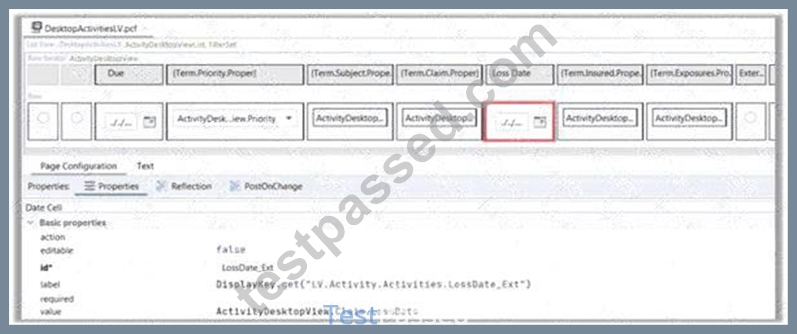
Which action should be taken to configure the date cell to follow best practices?
- A. Use an existing display key rather than creating a custom display key
- B. Use a text cell widget instead of a date cell widget and format the value as a string
- C. Extend the view entity to include the claim loss date rather than access it from Claim
- D. Configure the dateFormat property of the widget to display the date in a short format
Answer: C
Explanation:
In Guidewire InsuranceSuite, View Entities are specialized data model objects designed specifically for high- performance data retrieval in ListViews (LVs). Unlike standard entities, View Entities act similarly to database views, allowing the application to fetch a flattened set of data from multiple related tables in a single, optimized SQL query.
According to PCF Configuration and Data Model best practices, when a developer adds a column to a ListView backed by a View Entity, the value for that cell should ideally be a direct property of the View Entity itself. In the provided screenshot, the developer is using " dot-traversal " logic: ActivityDesktopView.
Claim.LossDate. This configuration requires the UI engine to traverse from the View Entity to the related Claim entity for every single row rendered in the list. While functional, this creates a significant performance overhead, as it can lead to " N+1 " query problems or inefficient memory usage when the list contains a large number of activities.
The verified best practice is to Extend the view entity (via an .etx file) to include the desired field. By adding a viewEntityColumn or viewEntityTypekey to ActivityDesktopView with a path of Claim.LossDate, the Guidewire platform includes this data in the initial projection of the SQL query used to populate the list.
Consequently, the ListView can access the date directly as ActivityDesktopView.LossDate_Ext. This architectural approach ensures that the user interface remains responsive and follows the SurePath performance standards required for both on-premise and Cloud-native Guidewire implementations.
NEW QUESTION # 44
An insurer wants to add a new typecode for an alternate address to a base typelist EmployeeAddress that has not been extended.
- A. Create an EmployeeAddress.tix file and add a new typecodealternate_Ext
- B. Create an EmployeeAddress_Ext.tti file and add a new typecodealternate
- C. Open the EmployeeAddress.tti and add a new typecode alternate
- D. Create an EmployeeAddress.ttx file and add a new typecodealternate_Ext
- E. Following best practices, which step must a developer take to performthis task?
Answer: D
Explanation:
In the Guidewire InsuranceSuite framework, maintaining the integrity of the base configuration is paramount for ensuring a smooth upgrade path. This is achieved through a strict " extension-only " philosophy for out-of- the-box (OOTB) components. When a developer needs to modify a base typelist-like EmployeeAddress- they must understand the distinction between .tti (Typelist Interface) files and .ttx (Typelist Extension) files.
A .tti file defines the original structure and initial typecodes of a typelist. These files are considered " base " and should never be edited directly (making Option C incorrect). If a developer were to modify the base .tti, those changes would be overwritten during the next platform update. To safely add a new typecode to an existing base typelist, Guidewire requires the creation of a .ttx file with the exact same name as the base typelist (e.g., EmployeeAddress.ttx). This extension file tells the Guidewire metadata engine to merge the new entries with the existing ones at runtime.
Furthermore, Guidewire best practices for metadata extensions require specific naming conventions to prevent future " namespace collisions. " While the .ttx file itself adopts the base name, the new typecode added within that file should be suffixed with _Ext (e.g., alternate_Ext). This ensures that if Guidewire later releases a product update that adds an " alternate " code to the base EmployeeAddress typelist, the customer ' s custom code remains unique and does not conflict with the new base code.
Option B is incorrect because you do not create a new .tti with an _Ext suffix for an existing list. Option E is incorrect because .tix is not a valid Guidewire metadata file extension; the correct extension is .ttx. Therefore, Option D is the only choice that follows the correct file creation and naming convention protocols required by the Guidewire development lifecycle.
NEW QUESTION # 45
A developer is creating an entity for home inspections that contains a field for the inspection date. Which configuration of the file name and the field name fulfills the requirement and follows best practices?
- A. HomeInspection.eti, InspectionDate.Ext
- B. HomeInspection_Ext.etx, InspectionDate
- C. HomeInspection.etx, InspectionDate.Ext
- D. HomeInspection_Ext.eti, InspectionDate.Ext
- E. HomeInspection.Ext.eti, InspectionDate
Answer: D
Explanation:
Guidewire ' s Metadata Naming Conventions are strictly enforced to ensure that customer code remains distinct from Guidewire ' s base product code, which is essential for seamless platform upgrades.
When creating a brand-new entity, the developer must use the .eti (Entity Interface) extension. Following Cloud Delivery Standards, the entity name itself must include the _Ext suffix. Therefore, HomeInspection_Ext.eti is the correct file structure. Regarding the fields within that custom entity, Guidewire best practices recommend applying the _Ext suffix to custom columns as well (Option B), even if the entity itself is custom. This provides a consistent visual indicator in Gosu code that the developer is interacting with an extension rather than a base product element.
Option A and C use the .etx extension, which is reserved for extending existing base entities (e.g., adding a field to Claim). Option D is incorrect because it lacks the mandatory suffix on the entity name. Option E uses an invalid file naming format. Following the convention in Option B ensures the data model is compliant with Guidewire ' s automated quality gates.
NEW QUESTION # 46
Succeed Insurance has a page in PolicyCenter with a large fleet of vehicles. They want multiple filters to show only a subset of vehicles. Which methods follow best practices?
- A. Add multiple Filter Options using Gosu Standard Query Filters.
- B. Implement filtering logic in the list view PCF using visible properties.
- C. Retrieve all policies and filter them in the application server layer.
- D. Use Gosu's where method on the retrieved collection in memory.
- E. Apply the filter using the Row Iterator configuration in the PCF.
- F. Add a ListView Filter widget to the ListView.
Answer: A
Explanation:
When dealing with alarge fleet of vehicles, performance is the primary concern. Retrieving thousands of vehicle records and filtering them in the application server's memory (Options E and F) is a high-risk anti- pattern that leads to latency and high memory consumption.
The best practice for implementing efficient UI filters on large datasets is to useGosu Standard Query Filters (Option C). These filters are added to the ListView's toolbar. When a user selects a filter (e.g., "Only Heavy Trucks"), the Guidewire platform translates that filter into a SQL WHERE clause. This allows thedatabaseto do the work, returning only the specific subset of vehicles requested. This "Database-First" approach ensures that the application server remains responsive and that the network traffic between the database and the application is kept to a minimum.
Option A (filtering on the Row Iterator) and Option B (using "visible" properties) still require the system to fetch all the data from the database first, which does not solve the underlying performance issue. Using Query Filters is the only scalable solution for InsuranceSuite applications managing high-volume data.
NEW QUESTION # 47
An insurer plans to offer coverage for pets on homeowners policies. Whenever the covered pet Is displayed in the user interface, it should consist of the pet ' s name and breed. For example: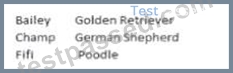
How can a developer satisfy this requirement following best practices?
- A. Create a display key that concatenates the pet ' s name and breed
- B. Define an entity name that concatenates the pet ' s name and breed fields
- C. Enable Post On Change for the pet name field to modify how it displays when referenced
- D. Create a setter property in a Pet enhancement class
Answer: B
Explanation:
In Guidewire InsuranceSuite, the global representation of a data object in the user interface is controlled by its Entity Name configuration. This configuration, stored in .en files within the metadata, defines how an instance of an entity is converted into a string whenever it is referenced in a widget like a RangeInput (dropdown), a TextCell in a list, or a read-only view.
According to the InsuranceSuite Developer Fundamentals course, the best practice for a requirement that applies " whenever the entity is displayed " is to define an Entity Name (Option B). This approach allows the developer to specify a template-often involving multiple fields-that the application server uses automatically. In this scenario, the developer would configure the Pet_Ext entity name to return a string like this.Name + " - " + this.Breed.
This method is superior to other options for several reasons:
* Centralization: You define the display logic once. If the business later decides to include the pet ' s age or color, you only update the .en file, and the change propagates across the entire application instantly.
* Performance: The Guidewire platform caches these display names efficiently. Using logic in every PCF (Option A) or creating manual display keys (Option D) increases the maintenance burden and can lead to inconsistent UI if a developer misses a specific screen.
* Declarative Nature: It follows the Guidewire philosophy of using metadata for structural and identity- related logic, keeping Gosu code reserved for complex business processes.
Options like Post On Change (Option A) are designed for UI refreshes and cannot change the underlying string representation of an object. A Setter (Option C) is used for writing data to the database and is irrelevant to how data is formatted for viewing.
NEW QUESTION # 48
The Officials list view in ClaimCenter displays information about an official called to the scene of a loss (for example, police, fire department, ambulance). The base product captures and displays only three fields for officials. An insurer has added additional fields but still only displays three fields. The insurer has requested a way to edit a single record in the list view to view and edit all of the officials fields. Which location type can be used to satisfy this requirement?
- A. Forward
- B. Location group
- C. Popup
- D. Page
Answer: C
Explanation:
In Guidewire InsuranceSuite UI design, balancing information density is a common challenge.List Views (LVs)are optimized for showing multiple records at once but are limited by horizontal screen real estate.
When an entity has more fields than can comfortably fit in a table-as is the case with the expanded
"Officials" entity-Guidewire best practices recommend using aPopup(Option C) for detailed editing.
A Popup is a specializedLocationtype that opens a secondary window over the current page. This allows the developer to embed a fullDetail View (DV)containing all the new fields (police badge numbers, department contact info, etc.) without navigating the user away from the main Claim screen. This "List-Detail" pattern is typically implemented by making one of the fields in the List View (like the Official's name) aLinkor by adding an "Edit" button that calls the popover or push method to launch the Popup.
Other location types are inappropriate for this specific requirement. AForward(Option A) is a non-visual location used for logical branching (deciding where to send a user based on data). APage(Option B) would take the user completely away from the current context, which is disruptive for a simple edit. ALocation Group(Option D) is used for structural navigation in the sidebar, not for individual record interaction. By utilizing a Popup, the developer provides a focused, high-density editing environment that maintains the user's workflow within the ClaimCenter application.
NEW QUESTION # 49
What is a commit in Git?
- A. A floating pointer to a stream of file changes
- B. A fixed pointer that identifies the changes to a file
- C. A snapshot of all of the files in a project
- D. A list of files with the changes made to each file over time
Answer: C
Explanation:
When working withGuidewire Cloud Platform (GWCP), developers use Git for version control.
Understanding the internal mechanics of Git is essential for managing InsuranceSuite configuration changes.
A common misconception is that Git stores "diffs" or just the changes made to files. However, according to theDeveloping with Guidewire Cloudtraining, acommitis fundamentally asnapshot of the entire project at a specific point in time.
When you perform a commit, Git takes a "picture" of what all your files look like at that moment. To stay efficient, if a file has not changed, Git doesn't store the file again; instead, it stores a link to the previous identical version it has already stored. This snapshot includes metadata such as the author, the timestamp, and a reference to the "parent" commit that came before it. This allows Git to reconstruct the entire state of the configuration at any point in history.
Option C is incorrect because it describes a pointer to changes (a delta), which is how older version control systems like SVN worked. Option B is more descriptive of a "Branch," which is a moving pointer to a commit. Option D describes the "History" or "Log" view. By treating every commit as a complete snapshot, Git ensures that the integrity of the Guidewire metadata is maintained, even when merging complex changes across different developer streams.
NEW QUESTION # 50
The Marketing department wants to add information for attorneys and doctors; For doctors, store the name of their medical school. For attorneys, store the name of their law school.
Which two data model extensions follow best practices to fulfill this requirement? (Select two)
- A. An entity named LawSchooLExt. and a foreign key to it from AB.Attorney
- B. A varchar column on ABAttorney, named LawSchooLExt
- C. An entity named MedSchooLExt and a foreign key to it from AB_Doctor
- D. An array on ABPerson. named ProfessionalSchools_Ext
- E. An entity named ProfessionalSchooLExt. storing the school ' s name and type
- F. A varchar column on ABDoctor, named MedSchool_Ext
Answer: B,F
Explanation:
When extending the Guidewire Data Model, developers must choose the most efficient storage mechanism based on the nature of the data and its relationship to existing entities. In this scenario, the requirement is to store a single piece of information-a school name-for two specific subtypes of person contacts: Doctors and Attorneys.
According to Guidewire best practices for Entity Extensions, if a piece of data has a one-to-one relationship with an entity and is a simple data type (like a String/Varchar), it should be added directly to the entity extension file (.etx) as a column. Options B and C follow this principle. By adding MedSchool_Ext to the ABDoctor entity and LawSchool_Ext to the ABAttorney entity, the developer ensures that the data is stored in the specific table where it is relevant. This avoids unnecessary complexity in the database schema and simplifies UI configuration, as the fields can be accessed directly from the object without traversing a foreign key or array.
Alternatives like creating separate entities for the school names (Options A, D, and F) or using an array on the base person entity (Option E) represent " over-engineering. " Creating a separate entity and a foreign key is only recommended if the data needs to be normalized (e.g., if multiple people share the exact same school record and that record has its own attributes like address or accreditation). In the context of a Marketing request to simply capture a name, adding a varchar column with the mandatory _Ext suffix is the most performant and maintainable approach. It keeps the database joins to a minimum and follows the Guidewire " KISS " (Keep It Simple, Stupid) principle for configuration.
NEW QUESTION # 51
What is a benefit of archiving?
- A. Reorganizes and compresses the contents of the database to conserve space.
- B. Re-indexes the contents of the database to increase data retrieval speed.
- C. Reduces database size by permanently removing data marked for purge.
- D. Improves application performance by reducing the size of the database.
Answer: D
Explanation:
Archiving is a vital strategy for long-term System Health and Quality within Guidewire InsuranceSuite, particularly for high-volume customers. As an application matures, the database accumulates a massive amount of " closed " or " historical " data (e.g., claims that were settled years ago or expired policies).
The primary benefit of archiving is that it improves application performance by moving this historical data out of the " active " operational database and into a secondary, long-term storage location (the Archive Store).
When the size of the active database is reduced, several performance gains are realized:
* Faster Queries: Database indexes become smaller and more efficient, leading to faster search and retrieval times for active claims and policies.
* Efficient Maintenance: Operations such as backups, index rebuilding, and database consistency checks run significantly faster on a leaner dataset.
* Reduced Resource Contention: With fewer rows for the database engine to manage, there is less strain on memory (buffer cache) and CPU.
It is important to distinguish archiving from Purging (Option B). Archiving preserves the data so it can be retrieved later if needed, whereas purging permanently deletes it. Archiving also differs from simple compression (Option D) or re-indexing (Option A), as it physically changes the location of the data to keep the primary production environment optimized for current business operations. This is a core concept in the Developing in the Cloud curriculum, where maintaining a performant SaaS environment is essential.
NEW QUESTION # 52
A developer needs to prepare their local configuration changes for inclusion in the shared Bitbucket repository. According to the training, which actions, performed using Git-based commands in a GWCP context, are essential for this process? (Choose 3)
- A. Deploying the application to a development planet.
- B. Configuring pre-promotion quality gates.
- C. Creating a new build schedule in TeamCity.
- D. Pulling the latest changes from the remote repository and rebasing the developer ' s commit(s).
- E. Pushing the finished branch to the remote Bitbucket repository.
- F. Committing the changes locally.
Answer: D,E,F
Explanation:
In the context of Developing in the Cloud and using the Guidewire Cloud Platform (GWCP), managing source code follows standard Git-based workflows integrated with Atlassian Bitbucket. For a developer to successfully share their local configuration changes with the rest of the team, they must follow a sequence that ensures code integrity and avoids " merge hell. " The first essential step is Committing the changes locally (Option B). This records the developer ' s progress in their local repository ' s history. However, because other developers may have pushed changes to the shared repository in the meantime, the developer must synchronize their local environment. This is achieved by Pulling the latest changes from the remote repository and rebasing (Option A). Rebasing is preferred in the Guidewire curriculum because it creates a clean, linear project history by moving the developer ' s custom commits to the " tip " of the updated master or feature branch. Finally, once the local branch is current and all conflicts are resolved, the developer must Push the finished branch to the remote Bitbucket repository (Option E). Only after the code is in Bitbucket can it be picked up by TeamCity for automated building and testing.
Deploying to a planet (Option C) and creating build schedules (Option D) are downstream activities that occur after the code has been successfully merged into the shared repository. Similarly, Quality Gates (Option F) are pre-configured environment standards rather than a step in the Git commit-and-push workflow. Adhering to the commit-rebase-push cycle is the verified best practice for collaborative cloud development.
NEW QUESTION # 53
When creating an entity enhancement in Gosu, which of the following practices are recommended? (Choose 2)
- A. Ensure that the enhancement file is placed in the same package as the enhanced type.
- B. Use a noun for most properties, but use an adjective for boolean properties.
- C. An enhancement to a subtype/subclass will need to be added to each child subtype/subclass as enhancements are not automatically inherited.
- D. Use the suffix _Ext for new methods added to custom entities.
- E. Use the suffix _Ext for new properties added to base application entities.
- F. Getters do not need to be null safe.
Answer: A,E
Explanation:
Entity Enhancements are a unique feature of the Gosu language that allow developers to " inject " new methods and properties into existing entities. Because these enhancements often target Base Application Entities (like Claim, Policy, or Account), following architectural best practices is vital to avoid system conflicts.
The first key practice (Option A) is the use of the _Ext suffix for any new properties or methods added to a base entity. This is a defensive programming strategy. If Guidewire releases a future update that includes a new field with the same name as a custom one, the _Ext suffix prevents a naming collision that could break the application or cause database metadata errors. Note that this is generally required for extensions to base entities, rather than custom ones (which are already unique).
The second critical practice (Option F) relates to the physical location of the enhancement file. For the Gosu compiler to correctly associate an enhancement with its target entity, the enhancement must be placed in the same package as the entity it is enhancing. For example, if a developer is enhancing ABContact (which resides in gw.pc.contact), the enhancement file must also be placed in the gw.pc.contact package within the configuration module.
Regarding the other options: Option E is a common misconception; in Guidewire, an enhancement applied to a supertype (like Contact) is automatically available to all of its subtypes (like Person or Company). Option C is a violation of general programming safety, as enhancements should always be defensive and null-safe to prevent NullPointerExceptions during UI rendering or rule execution.
NEW QUESTION # 54
An insurer has extended the ABContact entity in ContactManager with an array of Notes to capture information of interest about the contact over time. A developer has been asked to write a function to process all the notes for a given contact. Which code satisfies the requirement and follows best practices?
- A. while (exists (note in anABContact.Notes)) { //do something }
- B. for (i = 1..anABContact.Notes.length) { //do something }
- C. var aNote = anABContact.Notes.firstWhere( \ note - > note.Author != null) //do something
- D. for ( note in anABContact.Notes) { //do something }
Answer: D
Explanation:
Gosu is a powerful, statically typed language designed to work seamlessly with the Guidewire data model.
When a developer needs to iterate over an Entity Array-such as the Notes array on an ABContact- following the most readable and efficient syntax is a core requirement of InsuranceSuite Developer Fundamentals.
The for..in loop (Option B) is the idiomatic " best practice " in Gosu for iterating through collections. This syntax is clean, prevents " off-by-one " errors common in index-based loops, and automatically handles the iterator logic behind the scenes. In this example, note serves as the element variable that represents a single Note entity in each iteration of the loop. This approach is highly optimized for the Guidewire Bundle and Query API, ensuring that the system can efficiently manage the memory objects as the loop progresses.
Other options represent suboptimal or incorrect patterns:
* Option A: Uses a while loop with an exists check, which is syntactically incorrect for iterating through an entire list and would likely lead to an infinite loop or a compilation error.
* Option C: Uses a range-based loop with an index. This is less readable and more prone to error, especially since arrays in Gosu are 0-indexed, but the range starts at 1.
* Option D: Uses the firstWhere enhancement, which only returns the first matching element rather than processing all notes as required by the business analyst.
By using the standard for loop, the developer ensures that the code is maintainable, follows Gosu Coding Standards, and is easily understood by other Guidewire developers.
NEW QUESTION # 55
Which scenario follows best practices for user interface field-level validation?
- A. Store different social media profile addresses, regardless of the social media site involved.
- B. Proposed changes to user passwords contain only alphanumeric characters.
- C. The interest rate field is 0 whenever a down payment is greater than €5000.
- D. The city and state populate automatically whenever a US user enters their ZIP code.
Answer: B
Explanation:
In Guidewire PCF Configuration, field-level validation is used to ensure that the data entered by a user conforms to specific constraints (format, length, or character types) before the page is even committed to the database. According to the InsuranceSuite Developer curriculum, the best practice is to implement simple, immediate constraints at the field level to provide the user with rapid feedback.
Scenario A is a classic example of field-level validation. Ensuring that a password contains only alphanumeric characters can be enforced directly on the input widget using Input Masking or a Validation Expression within the PCF. This prevents invalid data from entering the system at the earliest possible stage. It improves the user experience by identifying the error immediately, rather than waiting for a full database commit to trigger a server-side validation rule.
In contrast, Scenario C describes Reflection or Post On Change behavior, which is a UI automation/helper feature rather than a validation check. Scenario D represents complex business logic or a " validation rule " that involves cross-field dependencies (interest rate vs. down payment); while this can be done in a PCF, it is more typically handled in a Validation Guide or a dedicated Gosu validation class to ensure the rule is enforced regardless of which UI screen is used. By focusing field-level validation on structural requirements like alphanumeric constraints, developers maintain a clear separation between data integrity (formatting) and business logic (eligibility/rules).
NEW QUESTION # 56
Which two are capabilities of the Guidewire Profiler? (Select two)
- A. Measure network latency between the database server and application server
- B. Measure network latency between the browser and application server
- C. Track where time is spent in Guidewire application code
- D. Track time spent in the web browser
- E. Provide timing information of application calls to external services
Answer: C,E
Explanation:
TheGuidewire Profileris an essential diagnostic tool used to capture and analyze performance data from the perspective of the application server. Its primary function is to help developers identify "hotspots"-areas of the code that consume excessive time or resources-during the execution of a specific transaction, such as a page load, a batch process, or a web service call.
According to theSystem Health & Qualitycurriculum, the first major capability of the Profiler istracking time spent within Guidewire application code(Option A). When profiling is active, the tool records the execution time of Gosu methods, business rules, and even PCF expressions. It provides a hierarchical "stack trace" view, allowing developers to see exactly which function or rule is responsible for a delay. This is particularly useful for detecting inefficient loops or complex logic that may be slowing down the user experience.
The second key capability isproviding timing information for external service calls(Option D). In a modern InsuranceSuite ecosystem, applications frequently communicate with external systems for credit scores, address validation, or payment processing. The Profiler monitors these "exit points" (such as SOAP or REST integrations) and records the duration of each call. By analyzing this data, a developer can determine if a performance issue is internal to the Guidewire application or if it is caused by a slow response from an external vendor's API.
It is important to note that the Profiler is aserver-side tool. It does not measure browser-side rendering time (Option E) or network latency between the client and the server (Option C). While it provides metadata about database queries, its focus is on the application's execution of those queries rather than raw network latency (Option B). By focusing on internal code and external integrations, the Profiler gives developers a clear view of the application's functional performance.
NEW QUESTION # 57
Which GUnit base class is used for tests that involve Gosu queries in PolicyCenter?
- A. PCServerTestClassBase
- B. SuiteDBTestClassBase
- C. PCUnitTestClassBase
- D. GUnitTestClassBase
Answer: A
Explanation:
In theGuidewire System Health & Qualitytraining, understanding the hierarchy of GUnit base classes is essential for writing effective automated tests.
While GUnitTestClassBase (Option A) provides basic testing functionality, it does not necessarily initialize the full application server environment or the database connection required for complex operations. For tests that require thefull Guidewire stack-including the ability to executeGosu queriesagainst the database or interact with the bundle-developers must usePCServerTestClassBase(Option D) in PolicyCenter (or CCServerTestClassBase in ClaimCenter).
This base class ensures that:
* The Guidewire Application Server environment is "mocked" or started.
* The current user session is authenticated.
* The database transaction manager (Bundles) is available for queries and commits.
Using a lower-level base class for a query-based test would result in a NullPointerException or a NoSessionException because the Query API requires an active server context to translate Gosu into SQL.
NEW QUESTION # 58
What type of Assessment Check ensures that applications have monitoring and logging frameworks in place?
- A. Operations
- B. Security
- C. Performance
- D. Upgrades
Answer: A
NEW QUESTION # 59
A developer needs to run multiple GUnit test classes so that they can be run at the same time. Which two statements are true about the included tests? (Select two)
- A. They must be based on the same GUnit base class
- B. They must set TestResultsDir property
- C. They must have the same @Suite annotation
- D. They must use the assertTrue() function
- E. They must be in the same GUnit class
Answer: A,C
Explanation:
In theGuidewire System Health & Qualitymodules, the focus is on scaling automated testing usingGUnit.
When a developer has a large number of tests, running them individually is inefficient. To group tests logically and execute them as a batch-often as part of a CI/CD pipeline in TeamCity-Guidewire utilizes Test Suites.
To group multiple test classes into a single suite (Option E), they must share the same @Suite annotation.
This annotation tells the GUnit runner that these classes are part of a specific collection, such as a "Smoke Test Suite" or a "Financials Logic Suite." This allows for structured execution and reporting across the entire implementation.
Additionally, for tests to run together effectively and share a consistent environment, they typicallymust be based on the same GUnit base class(Option A). In Guidewire, base classes like GWTestBase or custom insurer-specific base classes provide the necessary "scaffolding"-such as database connection handling, bundle management, and authentication-required for the tests to run within the InsuranceSuite framework.
Without a shared base class, individual tests might attempt to initialize the system in conflicting ways, leading to "flaky" tests or execution failures.
Options B and C are incorrect because the goal of a suite is to groupdifferentclasses, and properties like TestResultsDir are usually handled by the build runner (TeamCity) rather than the individual test code. Option D is a specific assertion method and has no bearing on how tests are grouped or executed in parallel.
NEW QUESTION # 60
You need to retrieve Claim entity instances created after a specific date. Which methods ensure that the filtering is performed in the database for optimal performance?
- A. Use the filter () .where () methods on the query object to filter the records by their creation date.
- B. Use the compare method on the query object to filter claim records by their creation date.
- C. Retrieve claims using a query and then filter the results collection using the filterwhere method.
- D. Retrieve all claims and filter the collection in Gosu memory using the where ( ) method.
- E. Use the where method on the query object to filter claim records by their creation date.
Answer: B
Explanation:
In Guidewire InsuranceSuite development, performance is heavily dependent on how data is retrieved from the relational database. When dealing with potentially large datasets, such as the Claim entity, it is critical to perform filtering at the database level (via SQL WHERE clauses) rather than at the application level (in Gosu memory).
The Guidewire Query API provides the primary mechanism for constructing these database-level filters.
When a developer creates a query object (e.g., gw.api.database.Query.make(Claim)), they must use specific methods to define the criteria that will be translated into a SQL query. The compare() method is the standard approach for adding these constraints. It allows the developer to specify the property (such as CreateTime), the comparison operator (such as GreaterThan), and the value (the specific date). Because the compare() method is called directly on the Query object before the query is executed, the filtering happens within the database engine.
In contrast, methods like where() or filter() used on a collection or a QueryBuilder result (Option A, C, and E) often trigger the execution of the query first, fetching all records into the Gosu application server ' s memory, and then discarding the ones that don ' t match. This " in-memory filtering " leads to severe performance degradation, high memory consumption, and potential " Out of Memory " errors. Option D correctly utilizes the Query API ' s ability to refine the result set at the source. Understanding the lifecycle of a query-from construction using compare() to execution-is a fundamental skill for any Guidewire developer to ensure the application remains scalable and responsive under high data volumes.
NEW QUESTION # 61
......
InsuranceSuite-Developer EXAM DUMPS WITH GUARANTEED SUCCESS: https://testking.testpassed.com/InsuranceSuite-Developer-pass-rate.html