


NSE8_812 Dumps 2026 - New Fortinet NSE8_812 Exam Questions
Free NSE8_812 Braindumps Download Updated on May 25, 2026 with 107 Questions
NEW QUESTION # 15
Refer to the exhibit.
A customer has deployed a FortiGate 300E with virtual domains (VDOMs) enabled in the multi-VDOM mode. There are three VDOMs: Root is for management and internet access, while VDOM 1 and VDOM 2 are used for segregating internal traffic. AccountVInk and SalesVInk are standard VDOM links in Ethernet mode.
Given the exhibit, which two statements below about VDOM behavior are correct? (Choose two.)
- A. The VDOM links are in Ethernet mode because they have IP addressed assigned on both sides.
- B. Root VDOM is an Admin type VDOM, while VDOM 1 and VDOM 2 are Traffic type VDOMs.
- C. You can apply OSPF routing on the VDOM link in either PPP or Ethernet mode
- D. Traffic on AccountVInk and SalesVInk will not be accelerated.
- E. OSPF routing can be configured between VDOM 1 and Root VDOM without any configuration changes to AccountVInk
Answer: C,D
NEW QUESTION # 16
Refer to the exhibit containing the configuration snippets from the FortiGate. Customer requirements:
* SSLVPN Portal must be accessible on standard HTTPS port (TCP/443)
* Public IP address (129.11.1.100) is assigned to portl
* Datacenter.acmecorp.com resolves to the public IP address assigned to portl The customer has a Let's Encrypt certificate that is going to expire soon and it reports that subsequent attempts to renew that certificate are failing.
Reviewing the requirement and the exhibit, which configuration change below will resolve this issue?
- A.

- B.

- C.

- D.

Answer: A
Explanation:
https://docs.fortinet.com/document/fortigate/7.4.1/administration-guide/822087/automatically-provision-a- certificate
NEW QUESTION # 17
An automation stitch was configured using an incoming webhook as the trigger named 'my_incoming_webhook'. The action is configured to execute the CLI Script shown:
- A.

- B.

- C.

- D.

Answer: C
Explanation:
The CLI script in option A will send the log message to the webhook server. The webhook server can then be configured to take any desired action, such as storing the log message in a database or sending an email notification.
The other options are incorrect. Option B will not send the log message to the webhook server because it does not contain the curl command. Option C will send the log message to the webhook server, but it will also include the FortiGate's IP address and MAC address. This information is not necessary, and it could be used by an attacker to identify the FortiGate. Option D will not send the log message to the webhook server because it does not contain the webhook action.
References:
Automation webhook stitches: https://docs.fortinet.com/document/fortigate/7.4.0/administration-guide/989735/webhook-action Webhooks: https://en.wikipedia.org/wiki/Webhook
NEW QUESTION # 18
A remote worker requests access to an SSH server inside the network. You deployed a ZTNA Rule to their FortiClient. You need to follow the security requirements to inspect this traffic.
Which two statements are true regarding the requirements? (Choose two.)
- A. You need to configure a FortiClient SSL-VPN tunnel to inspect the SSH traffic.
- B. SSH traffic is tunneled between the client and the access proxy over HTTPS
- C. Traffic is discarded as ZTNA does not support SSH connection rules
- D. FortiGate can perform SSH access proxy host-key validation.
Answer: B,D
Explanation:
ZTNA supports SSH connection rules that allow remote workers to access SSH servers inside the network through an HTTPS tunnel between the client and the access proxy (FortiGate). The access proxy acts as an SSH client to connect to the real SSH server on behalf of the user, and performs host-key validation to verify the identity of the server. The user can use any SSH client that supports HTTPS proxy settings, such as PuTTY or OpenSSH. Reference: https://docs.fortinet.com/document/fortigate/7.0.0/ztna-deployment/899992/configuring-ztna-rules-to-control-access
NEW QUESTION # 19
Refer to the exhibit.
A customer reports that they are not able to reach subnet 10.10.10.0/24 from their FortiGate device.
Based on the exhibit, what should you do to correct the situation?
- A. Enable recursive resolution for BGP routes
- B. Enable next-hop-self feature
- C. Enable additional-path feature
- D. Enable iBGP multipath
Answer: B
NEW QUESTION # 20
Refer to the exhibits, which show a firewall policy configuration and a network topology.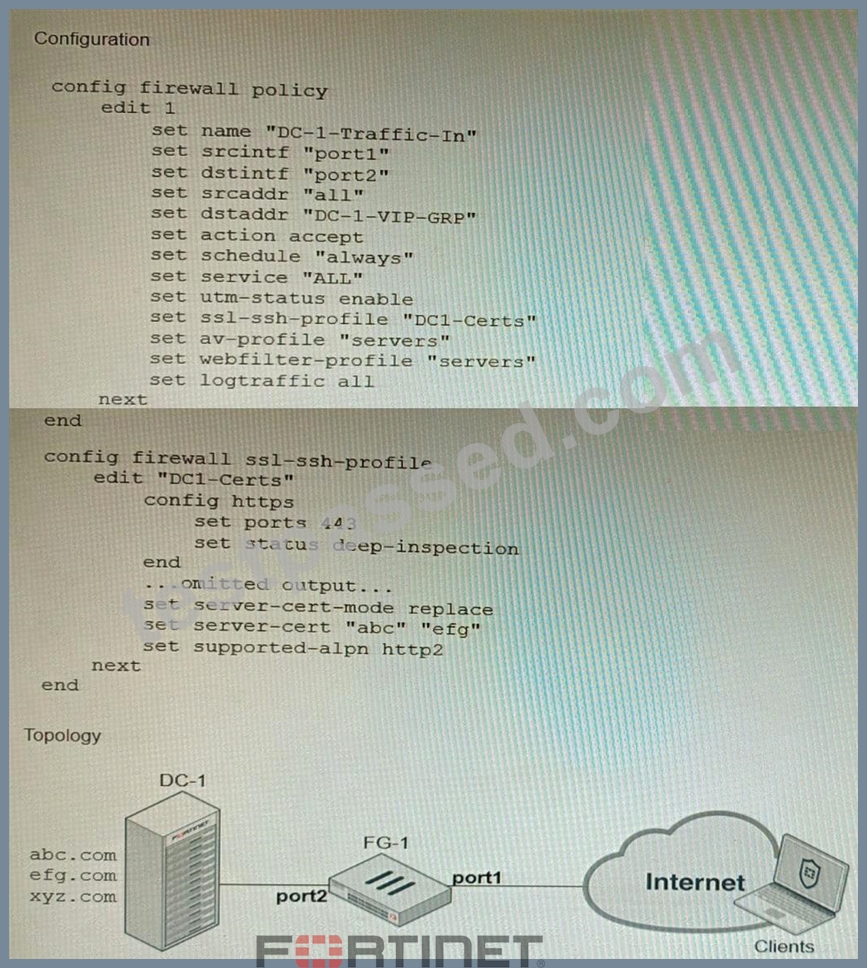
An administrator has configured an inbound SSL inspection profile on a FortiGate device (FG-1) that is protecting a data center hosting multiple web pages-Given the scenario shown in the exhibits, which certificate will FortiGate use to handle requests to xyz.com?
- A. FortiGate will reject the connection since no certificate is defined.
- B. FortiGate will fall-back to the default Fortinet_CA_SSL certificate.
- C. FortiGate will use the first certificate in the server-cert list-the abc.com certificate
- D. FortiGate will use the Fortinet_CA_Untrusted certificate for the untrusted connection,
Answer: C
Explanation:
https://docs.fortinet.com/document/fortigate/7.4.1/administration-guide/850344/define-multiple-certificates-in- an-ssl-profile-in-replace-mode If there is no matched server certificate in the list, then the first server certificate in the list is used as a replacement.
NEW QUESTION # 21
Refer to the exhibit.
You are operating an internal network with multiple OSPF routers on the same LAN segment. FGT_3 needs to be added to the OSPF network and has the configuration shown in the exhibit. FGT_3 is not establishing any OSPF connection.
What needs to be changed to the configuration to make sure FGT_3 will establish OSPF neighbors without affecting the DR/BDR election?
- A.

- B.

- C.

- D.

Answer: B
Explanation:
The OSPF configuration shown in the exhibit is using the default priority value of 1 for the interface port1.
This means that FGT_3 will participate in the DR/BDR election process with the other OSPF routers on the same LAN segment. However, this is not desirable because FGT_3 is a new device that needs to be added to the OSPF network without affecting the existing DR/BDR election. Therefore, to make sure FGT_3 will establish OSPF neighbors without affecting the DR/BDR election, the priority value of the interface port1 should be changed to 0. This will prevent FGT_3 from becoming a DR or BDR and allow it to form OSPF adjacencies with the current DR and BDR. Option B shows the correct configuration that changes the priority value to 0. Option A is incorrect because it does not change the priority value. Option C is incorrect because it changes the network type to point-to-point, which is not suitable for a LAN segment with multiple OSPF routers. Option D is incorrect because it changes the area ID to 0.0.0.1, which does not match the area ID of the other OSPF routers on the same LAN segment. References: https://docs.fortinet.com/document/fortigate/7.
0.0/administration-guide/358640/basic-ospf-example
NEW QUESTION # 22
Which two methods are supported for importing user defined Lookup Table Data into the FortiSIEM?
(Choose two.)
- A. SCP
- B. API
- C. Report
- D. FTP
Answer: B,C
Explanation:
FortiSIEM supports two methods for importing user defined Lookup Table Data:
* Report: You can import lookup table data from a report. This is the most common method for importing lookup table data.
* API: You can also import lookup table data using the FortiSIEM API. This is a more advanced method that allows you to import lookup table data programmatically.
FTP, SCP, and other file transfer protocols are not supported for importing lookup table data into FortiSIEM.
NEW QUESTION # 23
Refer to the exhibit that shows VPN debugging output.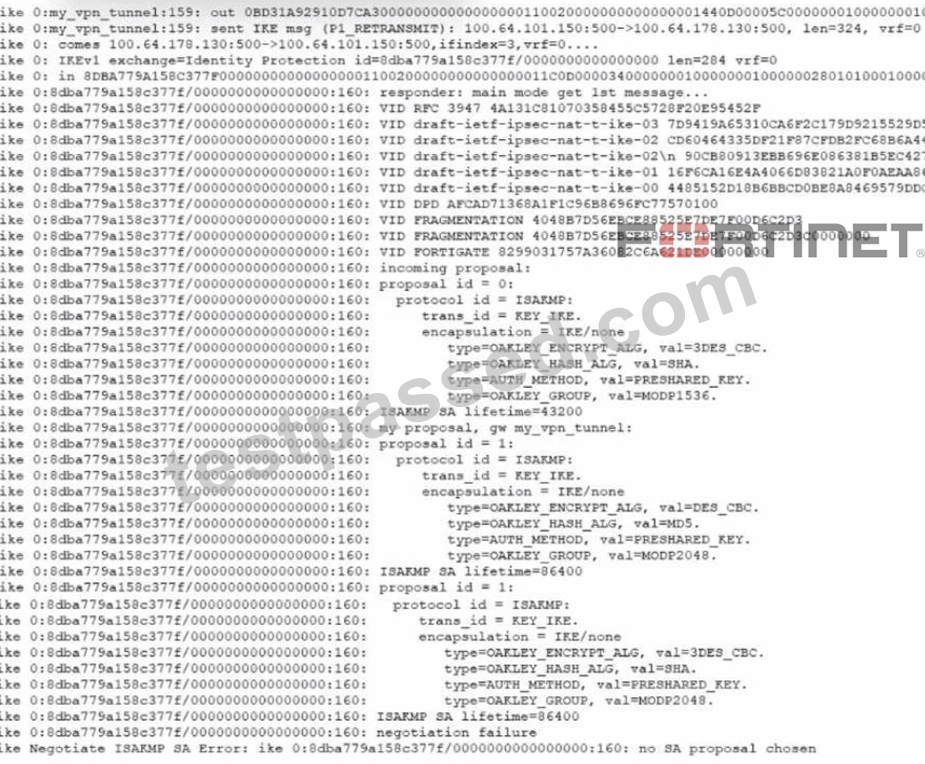
The VPN tunnel between headquarters and the branch office is not being established.
What is causing the problem?
- A. There is a mismatch in the ISAKMP SA lifetime.
- B. HQ is using IKE v1 and the branch office is using with IKE v2.
- C. There is no matching Diffie-Hellman Group.
- D. The Phase-1 encryption algorithms are not matching.
Answer: D
NEW QUESTION # 24
Refer to the exhibits.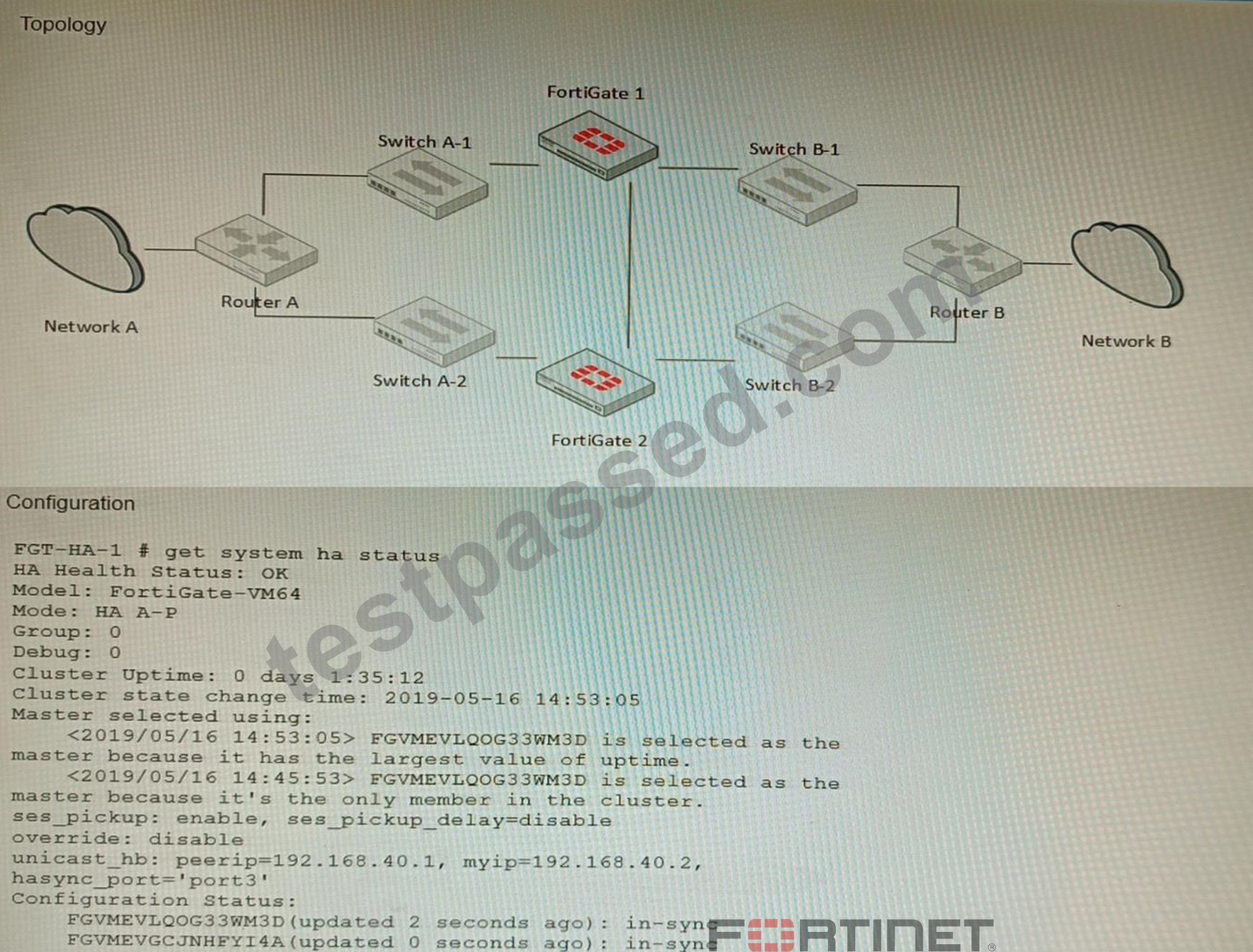
The exhibits show a FortiGate network topology and the output of the status of high availability on the FortiGate.
Given this information, which statement is correct?
- A. The cluster mode can support a maximum of four (4) FortiGate VMs
- B. FGVMEVLQOG33WM3D and FGVMEVGCJNHFYI4A share a virtual MAC address.
- C. The cluster members are on the same network and the IP addresses were statically assigned.
- D. The ethertype values of the HA packets are 0x8890, 0x8891, and 0x8892
Answer: B
Explanation:
The output of the status of high availability on the FortiGate shows that the cluster mode is active-passive, which means that only one FortiGate unit is active at a time, while the other unit is in standby mode. The active unit handles all traffic and also sends HA heartbeat packets to monitor the standby unit. The standby unit becomes active if it stops receiving heartbeat packets from the active unit, or if it receives a higher priority from another cluster unit. In active-passive mode, all cluster units share a virtual MAC address for each interface, which is used as the source MAC address for all packets forwarded by the cluster. References: https://docs.fortinet.com/document/fortigate/6.4.0/cookbook/103439/high-availability-with-two-fortigates
NEW QUESTION # 25
Refer to the exhibit.
A customer is trying to setup a Playbook automation using a FortiAnalyzer, FortiWeb and FortiGate. The intention is to have the FortiGate quarantine any source of SQL Injection detected by the FortiWeb. They got the automation stitch to trigger on the FortiGate when simulating an attack to their website, but the quarantine object was created with the IP 0.0.0.0. Referring to the configuration and logs in the exhibits, which two statements are true? (Choose two.)
- A. The Group By option in the handler should be different to src, so src can be used on the Playbook configuration.
- B. The FortiAnalyzer ADOM Type must be Fabric.
- C. FortiSOC Playbooks combining FortiWeb and FortiGate are not supported.
- D. To diagnose this issue, you need to use the command diagnose test application oftpd 22.
- E. To fix the issue the parameter for script on the Playbook configuration should be epip.
Answer: A,B
NEW QUESTION # 26
Refer to the exhibit.
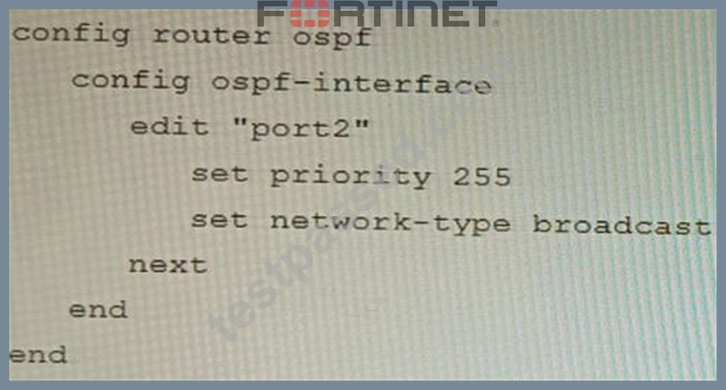
You are operating an internal network with multiple OSPF routers on the same LAN segment. FGT_3 needs to be added to the OSPF network and has the configuration shown in the exhibit. FGT_3 is not establishing any OSPF connection.
What needs to be changed to the configuration to make sure FGT_3 will establish OSPF neighbors without affecting the DR/BDR election?
- A.

- B.

- C.
- D.

Answer: A
Explanation:
The OSPF configuration shown in the exhibit is using the default priority value of 1 for the interface port1. This means that FGT_3 will participate in the DR/BDR election process with the other OSPF routers on the same LAN segment. However, this is not desirable because FGT_3 is a new device that needs to be added to the OSPF network without affecting the existing DR/BDR election. Therefore, to make sure FGT_3 will establish OSPF neighbors without affecting the DR/BDR election, the priority value of the interface port1 should be changed to 0. This will prevent FGT_3 from becoming a DR or BDR and allow it to form OSPF adjacencies with the current DR and BDR. Option B shows the correct configuration that changes the priority value to 0. Option A is incorrect because it does not change the priority value. Option C is incorrect because it changes the network type to point-to-point, which is not suitable for a LAN segment with multiple OSPF routers. Option D is incorrect because it changes the area ID to 0.0.0.1, which does not match the area ID of the other OSPF routers on the same LAN segment. References: https://docs.fortinet.com/document/fortigate/7.0.0/administration-guide/358640/basic-ospf-example
NEW QUESTION # 27
Refer to the exhibit.
You have been tasked with replacing the managed switch Forti Switch 2 shown in the topology.
Which two actions are correct regarding the replacement process? (Choose two.)
- A. CLAG-ICL needs to be manually reconfigured once the new switch is connected to the FortiGate
- B. MCLAG-ICL will be automatically reconfigured once the new switch is connected to the FortiGate.
- C. After replacing the FortiSwitch unit, the automatically created trunk name changes.
- D. After replacing the FortiSwitch unit, the automatically created trunk name does not change
Answer: A,D
Explanation:
* A is correct because the automatically created trunk name is based on the MAC address of the FortiSwitch unit. When the FortiSwitch unit is replaced, the MAC address will change, but the trunk name will not change.
* B is correct because CLAG-ICL is a manually configured link aggregation group. When the FortiSwitch unit is replaced, the CLAG-ICL configuration will need to be manually reconfigured on the new FortiSwitch unit.
The other options are incorrect. Option C is incorrect because the automatically created trunk name does not change when the FortiSwitch unit is replaced. Option D is incorrect because MCLAG-ICL is a manually configured link aggregation group and will not be automatically reconfigured when the FortiSwitch unit is replaced.
References:
Configuring link aggregation on FortiSwitches | FortiSwitch / FortiOS 7.0.4 - Fortinet Document Library Managing FortiLink | FortiGate / FortiOS 7.0.4 - Fortinet Document Library
https://docs.fortinet.com/document/fortiswitch/7.0.8/devices-managed-by-fortios/173284/replacing-a- managed-fortiswitch-unit
NEW QUESTION # 28
Review the VPN configuration shown in the exhibit.
What is the Forward Error Correction behavior if the SD-WAN network traffic download is 500 Mbps and has 8% of packet loss in the environment?
- A. 3 redundant packet for every 9 base packets
- B. 1 redundant packet for every 10 base packets
- C. 2 redundant packet for every 8 base packets
- D. 3 redundant packet for every 5 base packets
Answer: D
Explanation:
Forward Error Correction (FEC) is a feature that can improve the quality of SD-WAN network traffic by adding redundant packets to the original packets. The ratio of redundant packets to base packets is determined by the FEC mode, which can be set to low, medium, or high. In low mode, the ratio is 1:10, in medium mode, the ratio is 2:8, and in high mode, the ratio is 3:5. The FEC mode can be configured manually or automatically based on the bandwidth and packet loss of the network. In this case, since the download bandwidth is 500 Mbps and the packet loss is 8%, the FEC mode is automatically set to high, which means that 3 redundant packets are added for every 5 base packets. Reference: https://docs.fortinet.com/document/fortigate/7.0.0/sd-wan/19662/forward-error-correction-fec
NEW QUESTION # 29
Refer to the exhibits, which show a topology and diagnostic commands.
Which two statements about the path resolution are true? (Choose two.)
- A. Latency is the quality criteria.
- B. wan2 is currently used as an outgoing interface.
- C. wan1 is currently used as an outgoing interface.
- D. Packet-loss is the quality criteria.
Answer: A
NEW QUESTION # 30
What is the benefit of using FortiGate NAC LAN Segments?
- A. It provides support for multiple DHCP servers within the same VLAN.
- B. It allows for assignment of dynamic address objects matching NAC policy.
- C. It provides support for IGMP snooping between hosts within the same VLAN
- D. It provides physical isolation without changing the IP address of hosts.
Answer: D
Explanation:
FortiGate NAC LAN Segments are a feature that allows users to assign different VLANs to different LAN segments without changing the IP address of hosts or bouncing the switch port. This provides physical isolation while maintaining firewall sessions and avoiding DHCP issues. One benefit of using FortiGate NAC LAN Segments is that it allows for assignment of dynamic address objects matching NAC policy. This means that users can create firewall policies based on dynamic address objects that match the NAC policy criteria, such as device type, OS type, MAC address, etc. This simplifies firewall policy management and enhances security by applying different security profiles to different types of devices.References:https://docs.fortinet.
com/document/fortigate/7.0.0/new-features/856212/nac-lan-segments-7-0-1
https://docs.fortinet.com/document/fortigate/7.0.0/new-features/856212/nac-lan-segments-7-0-1
NEW QUESTION # 31
Which two types of interface have built-in active bypass in FortiDDoS devices? (Choose two.)
- A. QSFP+
- B. SFP
- C. Copper
- D. LC
- E. SFP+
Answer: C,D
Explanation:
https://help.fortinet.com/fddos/4-3-0/FortiDDoS/Built_in_bypass.htm
NEW QUESTION # 32
Refer to the exhibits.
A customer has deployed a FortiGate with iBGP and eBGP routing enabled. HQ is receiving routes over eBGP from ISP 2; however, only certain routes are showing up in the routing table-Assume that BGP is working perfectly and that the only possible modifications to the routing table are solely due to the prefix list that is applied on HQ.
Given the exhibits, which two routes will be active in the routing table on the HQ firewall? (Choose two.)
- A. 172,620,64,27
- B. 172.16.204.64/27
- C. 172.16.201.96/29
- D. 172.16.204.128/25
Answer: A,D
Explanation:
A is correct because 172.16.204.128/25 matches the prefix list entry 172.16.204.0/24 ge 25 le 25. C is correct because 172.16.204.64/27 matches the prefix list entry 172.16.204.0/24 ge 27 le 27. Reference: https://docs.fortinet.com/document/fortigate/7.4.0/administration-guide/978793/bgp
NEW QUESTION # 33
......
Fortinet NSE8_812 Exam Practice Test Questions: https://testking.testpassed.com/NSE8_812-pass-rate.html