


ISTQB CTFL-2018 Dumps Questions [2023] Pass for CTFL-2018 Exam
Updated ISTQB Study Guide CTFL-2018 Dumps Questions
What Does CTFL 2018 Exam Include?
CTFL 2018 falls within the Foundation Level and thus emphasizes key concepts the candidates should master to advance their knowledge further. It validates one’s familiarity with the most important testing tools, methods, test management, understanding of the lifecycle of software development, and many others. Once you garner the requisite scores in it, you will be awarded the Certified Tester Foundation Level (CTFL) certification. Having it, you will be able to choose between Agile, Core, and Specialist paths and proceed to the Advanced as well as the Expert Levels.
Who Should Take CTFL 2018 Exam?
CTFL 2018 test is created for the industry beginners who expect to venture into different roles that include testers, test engineers, test managers, test analysts, and software developers. If you intend to operate as a user acceptance software tester, then the exam will be beneficial for you too. Moreover, the professionals of the related fields that require such knowledge can take advantage of CTFL 2018. These are business analysts, consultants, project managers, software development managers, project managers, etc.
NEW QUESTION 24
Which of the following is an approach that can be used for exploratory testing?
- A. A tester methodically executes tests from a list of possible failures, based on experience, defect and failure data.
- B. Tests are designed based on the guidance of stakeholders and experts outside the test team.
- C. A tester analyses, designs and implements tests based on external rules and standards.
- D. Time-boxed test sessions are created, during which a tester uses a test charter containing test objectives to guide the testing.
Answer: B
NEW QUESTION 25
When can functional and structural testing BOTH be applied?
- A. All 'Development' test levels, i.e. those before Acceptance testing.
- B. System and Component test levels only.
- C. Component and Component integration test levels only.
- D. All test levels.
Answer: D
NEW QUESTION 26
Which statement about deriving test cases from a use case is TRUE?
- A. It is not possible to measure use case test coverage.
- B. There should only be one test case for each use case.
- C. Test cases can only be derived if there is an activity diagram.
- D. Test cases are designed to exercise the defined behaviours.
Answer: D
NEW QUESTION 27
You are performing a review of your colleague's test cases based on the following test basis document:
The Test Cases are as follows:
TC1. Success - valid 'User Name' and 'Password'; Customer Menu displayed TC2. Failure - 'User Name' field has blank entry; Error Number 12 displayed TC3. Failure - 'User Id' entered does not exist on database (i.e. unregistered user); Error Number 23 displayed TC4. Failure - 'Password' entered does not match user's password on database; Error Number 24 displayed You are guided by the following checklist in your review:
C1. There must be one test case to cover success
C2. There must be one test case for each error path (e.g. validation failure) C3. Each test case must use terminology consistent with the test basis document (field names, error numbering, etc.) Record a separate defect for each missing test case (checklist items C1 and C2) and for each test case that does not meet checklist item C3.
How many defects should you record?
- A. 1.
- B. 4.
- C. 2.
- D. 3.
Answer: D
NEW QUESTION 28
In which development life cycle model is regression testing an increasingly important activity as the project progresses?
- A. Scrum.
- B. Progressive.
- C. Waterfall.
- D. V-model.
Answer: A
NEW QUESTION 29
Testing effort can depend on a number of factors, which one of the following is MOST likely to impact the amount of effort required?
- A. The ratio of developers to testers in the project team.
- B. The predicted number of defects and the amount of rework required.
- C. The planned use of a project management tool to schedule tasks.
- D. The responsibilities for testers and developers being clearly defined.
Answer: C
NEW QUESTION 30
Which of the following BEST describes how configuration management supports the test process?
- A. It helps the test manager to decide how best to integrate and coordinate the testing activities into the software life cycle.
- B. It enables the tester to reproduce the tested item through unique identification and version control.
- C. It enables the tester to systematically design test conditions, cases and data.
- D. It enables incidents to be tracked from discovery and classification to correction and confirmation of the solution.
Answer: B
NEW QUESTION 31
Given the following state transition diagram where SS is the start state: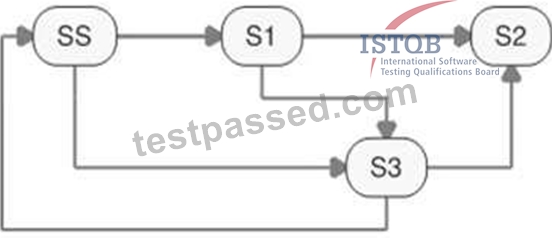
Which of the following answers describes a test case that only uses valid transitions to exercise all states, using the minimum number of transitions?
- A. SS-S1-S2-S3.
- B. SS-S3-SS-S1-S3-S2.
- C. SS-S1-S3-S2.
- D. SS-S3-S2-S1.
Answer: C
NEW QUESTION 32
During which stage of the fundamental test process is the testability of requirements evaluated?
- A. Test Execution.
- B. Test Design.
- C. Test Planning.
- D. Test Analysis.
Answer: D
NEW QUESTION 33
A student needs to score at least 50 points to pass. If they score at least 100 points they will achieve a merit and if they score at least 150 points they will achieve a distinction.
Which two values are in the same partition?
- A. 45 and 170.
- B. 50 and 60.
- C. 45 and 55.
- D. 55 and 120.
Answer: B
Explanation:
Explanation
NEW QUESTION 34
Which of the following is a key difference between black box and white box test design techniques?
- A. White box techniques derive test cases from models of the software, black box techniques do not.
- B. White box techniques can measure the extent of code coverage, black box techniques can not.
- C. Black box techniques use software code to derive test cases, white box techniques do not.
- D. White box techniques use functional design specifications to derive test cases, black box techniques do not.
Answer: B
NEW QUESTION 35
Which of the following are triggers for Maintenance testing?
a) System migration from one platform to another.
b) Retirement of a system.
c) Preparation for an audit of a system.
d) Modifications to a system.
e) Development of a whole new system.
- A. b, c and e.
- B. a, c and d.
- C. a, d and e.
- D. a, b and d.
Answer: B
NEW QUESTION 36
Which of the following is a typical characteristic of the WALKTHROUGH review type?
- A. Attendees must prepare before the meeting.
- B. Entry and exit criteria are defined.
- C. The meeting is led by the author.
- D. Metrics are gathered throughout.
Answer: C
NEW QUESTION 37
Which option BEST describes how the level of risk is determined?
- A. The consequences of potential problem multiplied by the cost of possible legal action.
- B. The likelihood and the probability of a hazard occurring.
- C. The likelihood of an adverse event happening multiplied by the cost of preventing it.
- D. The impact of an adverse event multiplied by the likelihood of that event occurring.
Answer: D
NEW QUESTION 38
Which of the following options BEST explains the pesticide paradox principle of testing?
- A. If we do not regularly review and revise our tests, we'll stop finding defects.
- B. Repeatedly running a set of tests will ensure that a system is defect free.
- C. Testing, like spraying pesticide, is an effective bug/defect removal activity.
- D. Defects are, paradoxically, often contained in a small number of modules.
Answer: D
Explanation:
Explanation/Reference:
NEW QUESTION 39
Given the following state transition diagram where SS is the start state:
Which of the following answers describes a test case that only uses valid transitions to exercise all states, using the minimum number of transitions?
- A. SS-S1-S2-S3.
- B. SS-S3-SS-S1-S3-S2.
- C. SS-S1-S3-S2.
- D. SS-S3-S2-S1.
Answer: C
NEW QUESTION 40
......
Achieve Success in Actual CTFL-2018 Exam CTFL-2018 Exam Dumps: https://testking.testpassed.com/CTFL-2018-pass-rate.html